
Polycrisis and the Century Plan: Designing Chicagoland for the 22nd Century
Kyle Schulz is deputy of strategic advancement at the Chicago Metropolitan Agency for Planning, the urban planning organisation for the region. He arrived at Nivan Live asking whether an urban planner belonged in a room full of designers and technologists, and then delivered the session that gave the entire day its longest time horizon. His subject was a plan for the twenty second century and the compounding crises it has to survive.
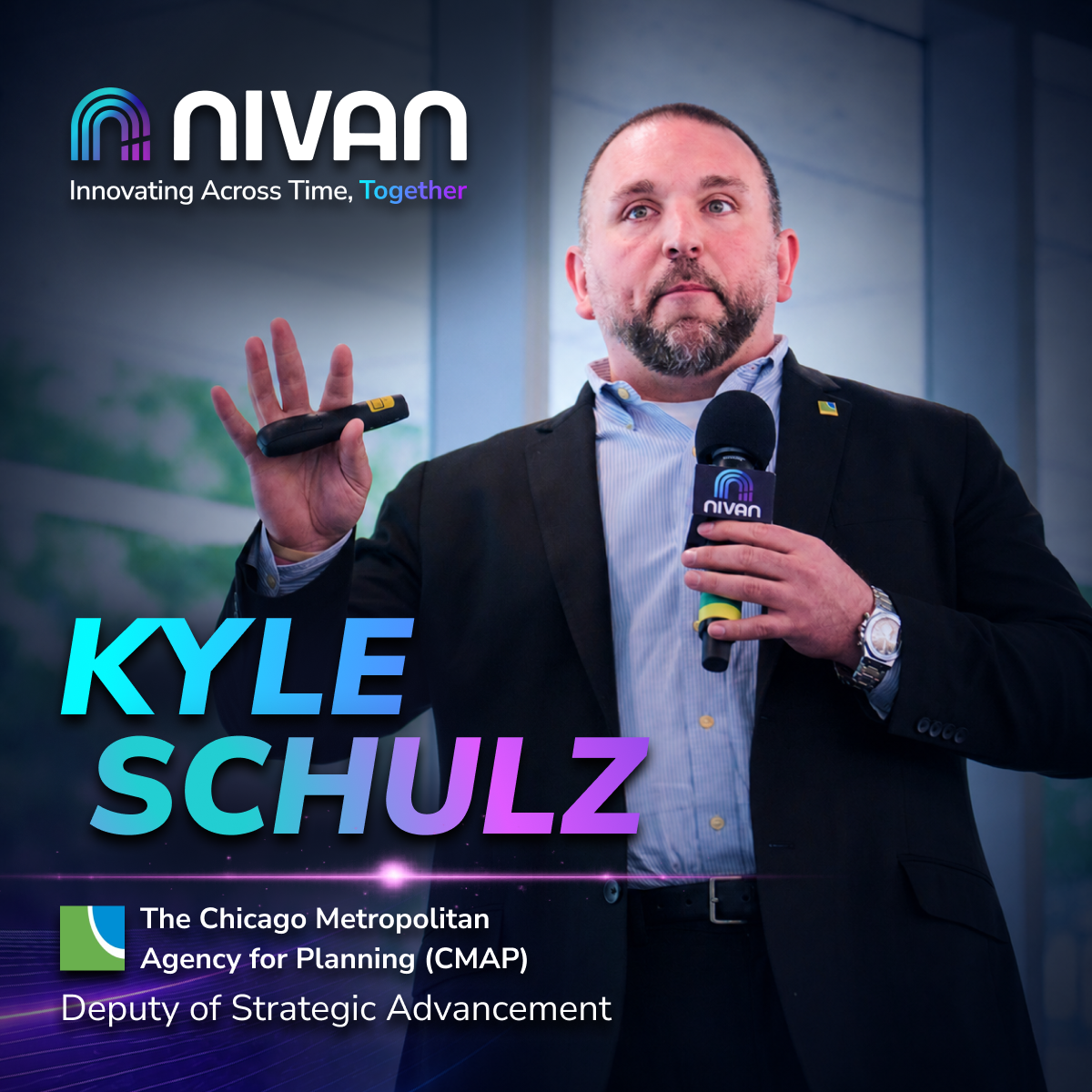
Kyle Schulz at Nivan 2026
Standing on someone else's plan
Kyle situated his work inside a lineage that includes Frederick Law Olmsted, whose Chicago contribution, Jackson Park, is about to receive roughly a million and a half visitors a year once the Obama Center opens. But the figure that matters to his agency is Daniel Burnham, who has a star on the Chicago flag and whose 1909 Plan of Chicago asked what the city should become after the fire and the Columbian Exposition.
What a plan can still be doing a century later
The legacy items are not abstractions. The Cook County Forest Preserve came from that plan. So did Navy Pier, which attracts more visitors than every major sports team's home games combined. Most consequentially, the lakefront was preserved. Kyle noted the physical document runs one hundred sixty four pages and weighs five and a third pounds, and that his agency keeps a copy, which he weighed to be certain.
What the agency actually does
The Chicago Metropolitan Agency for Planning is twenty years old, formed by consolidating two planning agencies. Its remit is twofold: ensure the transportation system is equitable and inclusive, and understand how that system interacts with land use. Most residents have never heard of it and have been affected by it, including through the most consequential transportation reform in Illinois in fifty years and one of the boldest transportation financing plans in the country in fifteen.
Quantum in a former steel neighbourhood
Kyle also pointed to regional economic work that brought a company building the first quantum supercomputer in the United States to South Chicago, reimagining what a steel mill site becomes in the twenty first and twenty second centuries. His aside was pointed for a room that had spent all day on AI. He enjoys the AI conversation and expects quantum to move past it, while acknowledging he is paid to say so.
The density problem in planning itself
The current guiding document, adopted in 2018, runs three hundred sixty seven pages with eighty policy recommendations expanding into four hundred twenty five strategic action items. Kyle was candid that almost nobody outside academia has read it or could describe its contents. He named that as one of the real problems facing urban planning, which is a design problem before it is a policy one.
Polycrisis
The theme that surfaced repeatedly as the new Century Plan developed was polycrisis. His plain language definition is a condition where everything that can be on fire is on fire simultaneously. The regional list includes increasing surveillance, energy demand straining the grid, an affordability crisis, flooding and climate risk, broken supply chains, and technology adopted faster than people or governments can absorb.
Demographics as a slow emergency
One number reframes everything else. The region has been the third largest in the country for decades. As it approaches 2060, forty eight percent of its two hundred eighty four municipalities will have an average population age above seventy. That single trend places pressure on every system the agency touches, and it arrives regardless of any decision made in the interim.
Water as the long horizon asset
Chicagoland sits beside roughly a fifth of the world's fresh water and has advertised that as its future. The complications are specific. A third of the region's communities are not on the lake and rely on an aquifer drying faster than it replenishes, which means they will need to connect. The infrastructure that connects existing communities is ageing and expensive to repair. And a 1967 consent decree governs how much water may be withdrawn. Water becomes the magnet for climate migration, which their forecasts place around 2080.
Housing as the immediate one
The third largest metropolitan region in the country produced roughly as much housing in 2025 as Oklahoma City. Kyle put the requirement at approximately one hundred eighty thousand units per year over the next five years simply to maintain the current position, before any ambition to grow. The consequences run through economic growth and the tax base.
Data centres as this century's railroads
His most useful analogy reframed a contentious subject. In the nineteenth century, railroads were enormous physical infrastructure investments, cash intensive, arriving faster than the public sector or the population could absorb, and the region negotiated a system that worked and built the Chicagoland economy on it. Data centres occupy the same position now, offering reliable property tax revenue to strained municipal budgets while creating visible tension against wage growth that is barely keeping pace with inflation. The question is whether that becomes engineering and mechanical jobs and a more productive workforce, or a fight.
Why the process is different this time
Burnham and his contemporaries built plans with very little engagement, essentially in a back room. Kyle was explicit that the Century Plan cannot work that way. Transformational change requires national, state, local and neighbourhood government together, and it requires business, academia, national laboratories, designers, nonprofits and philanthropy to agree on which core bets matter. The agency is currently listening, spotting early solutions and assembling that coalition.
Hearing it coming
He borrowed a line from David Bowie as the plan's North Star, that tomorrow belongs to those who can hear it coming, and added that one head and two ears is not sufficient equipment for hearing the future. His invitation to the room was to contribute to the plan directly, and his stated ambition, offered half seriously, is a fifth star on the Chicago flag.
