
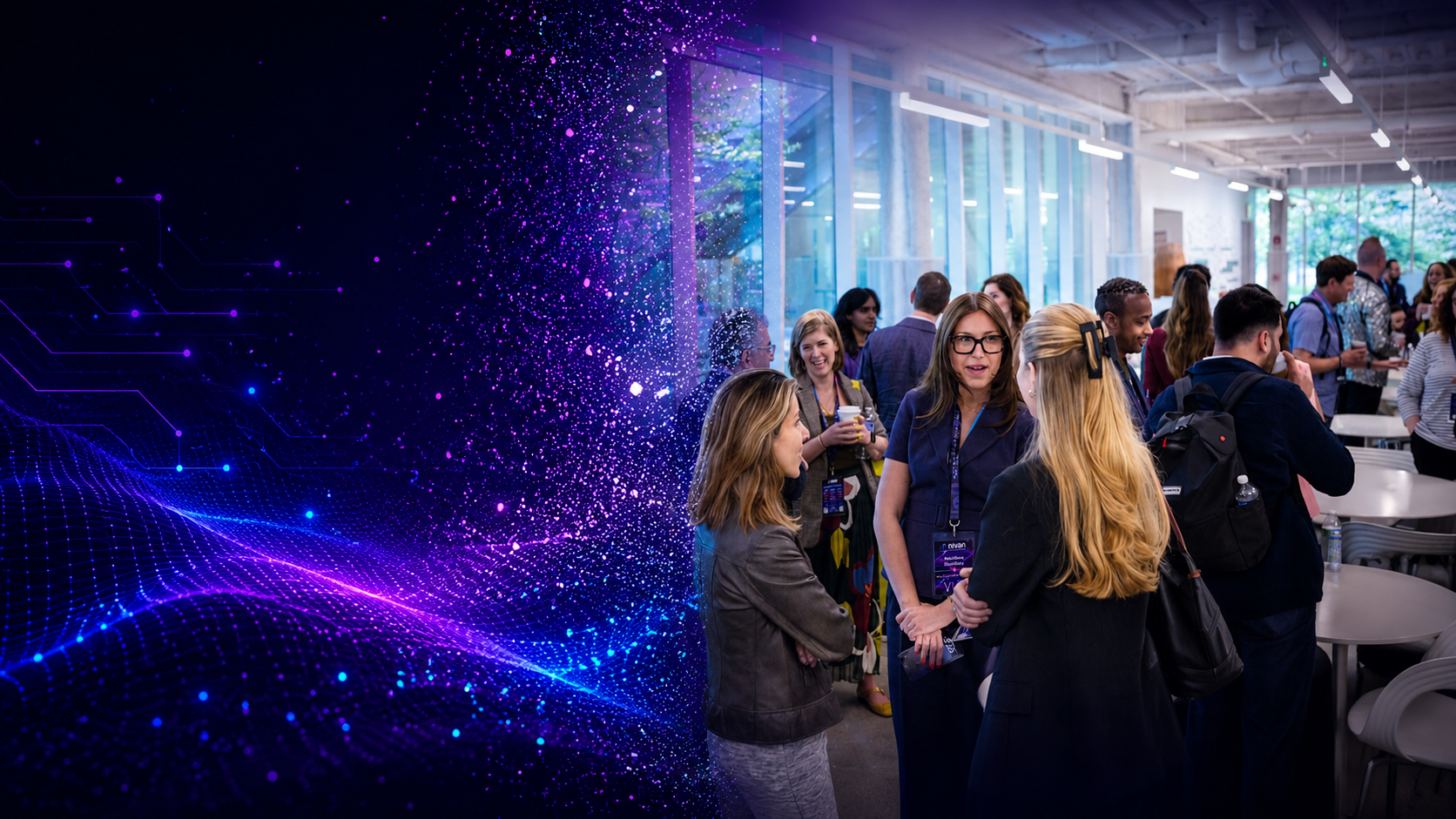

Opening Welcome
Niketa Jhaveri opens Nivan 2026 with the Time Travel framework: what past is this AI carrying, what present is it shaping, what future is it foreclosing.
Opening Welcome by Niketa Jhaveri
Founder & Curator, Nivan
MC by Carlos Manalo
Co-CEO, The Office of the Experience

Keynote
Back to the Future: Where Eras Converge
The systems we inherit shape the systems we build. From legacy data to future-scale decisions, this session connects history, judgment, and direction into one continuous arc.
Keynote Speaker
Former Head of Design, Fidelity Investments

Reflect on the Past
Learning from what shaped us.Scale vs. Craft
Debating whether expansion strengthens or dilutes meaningful design.
Noel Childs
SVP Group Experience Design Director, Digitas
vs.
David Kazaryan
Senior Product Design Manager, United Airlines
The Tools That Shaped Us
The essential approaches innovators rely on to navigate complexity and create change.
Bob Nesbitt
Former Director of Portfolio Strategy, AbbVie
Former Director of Advanced Development, Eli Lilly and Company
Patterns That Refuse to Disappear
Rapid perspectives on defining decisions that reshaped the field.
Linnea Hagen
Consumer Insights Manager, Netflix
Realize the Present
Designing and building in today’s reality.Lightning Talk: The Present
The choices we make with AI today define what comes next across industries.
Gavin Lew
Managing Partner, Bold Insight
The Ecological, Relational, Emotional, and Cultural Lenses for AI Transformation
Exploring the future through 4 core lenses.
Suzanne Currie
Director of AI/UX Research, Geico
Human Judgment vs. AI Assistance
Examining where human intuition and machine intelligence intersect.
Bennett Hornbostel
Principal UX Researcher, Amazon
vs.
Varun Kapoor
Lead Product Designer, Microsoft
The "Bug Free" Workforce
How AI efficiency is subtly disrupting the interactions that build strong teams.
Casey Hudetz
Senior Product Design Manager, Docusign
Interactive Workshop
Identifying early signals within complexity and noise.
Anthony Bynum
Associate Professor & Director, Institute of Design Executive Academy
Reimagine the Future
Shaping what comes next.The Future Won’t Design Itself
Why North Stars matter more than roadmaps.
Ben Shown
Head of Design, Blink UX
Designing the Next Chicago
Insights into the future of Chicago and its urban landscape.
Kyle Schulz
Deputy of Strategic Advancement, Chicago Metropolitan Agency for Planning (CMAP)
Personalization vs. Privacy
Where should we draw the line between meaningful personalization and personal privacy?
Sarah Wallace
Customer Experience Strategist, Proprietary Insights
vs.
Eric Smallwood
Former Director of Design, Walmart
Lightning Talk: The Future
Progress is inevitable. Direction is not. What future are we choosing to create?
Matthew Alverson
Partner, IA Collaborative
Designing the AI Continuum
Fast-moving insights weaving trust and innovation into the patient journey.
Kevin Yuda
Senior Director, UX, GE Healthcare
Your Data Can’t See the Future: The Hidden Risk in Modern Product Decisions
How design leaders influence strategy long before outcomes are visible.
Ashley Craig
VP, Research & Product Strategy, AnswerLab
Talk summaries and key moments
A written summary of every Nivan 2026 talk, with links that open the video at the exact moment.
Opening Welcome
Niketa Jhaveri, Curator of Nivan, and Carlos Manalo, Master of Ceremonies and Co-CEO of The Office of Experience
Niketa Jhaveri and master of ceremonies Carlos Manalo open Nivan Live 2026 inside the Institute of Design at Illinois Tech, a building shaped by László Moholy-Nagy and the New Bauhaus movement. Carlos asks the room to carry that legacy of design and technology through the day, which is organized as past, present and future, with 19 speakers from 11 industries in one room.
Niketa explains why Nivan exists. The conference circuit has become fast and shallow, so Nivan brings the past, the present and the future into one room under the line "Innovating Across Time, Together." She breaks down the name: Ni for intention and reflective clarity, van for dialogue and momentum, from a Sanskrit root, the point where reflection meets motion.
She names the stakes: invisible decisions inside algorithms, recommender systems and AI assistants quietly shape society, and innovation without humanity becomes dangerous. The question underneath every session is how to move forward without losing what makes us human.
The welcome previews the three innovation portals, the Creative Duel debates where ideas argue in the open, the Time Capsule for sealing a prediction to open in 2027, and Message to the Future, a private reminder from your past self. It closes with a personal story about her father, who taught a daughter in Mumbai how to walk into a room not built for her, and a call to see beyond what already exists.
Key moments
- 0:00 Carlos opens: the building we're standing in
- 0:52 László Moholy-Nagy and the New Bauhaus
- 2:32 The day's architecture: past, present, future
- 3:56 Niketa: set down what you carried in
- 4:33 Thank yous
- 5:29 Why this room matters now
- 6:44 Why we built Nivan differently
- 8:10 The name: Ni and van
- 8:49 Invisible decisions and who gets seen
- 10:11 The three portals: past, present, future
- 12:08 Creative Duel and the Time Capsule
- 13:26 My father, and walking into rooms not built for you
- 15:03 We are a community, not a conference
Back to the Future: Where Eras Converge
Nick Allen, Former Head of Design, GE Healthcare
Nick Allen, former Head of Design at GE Healthcare, tells his career as a series of problems solved by getting shoulder to shoulder with the people who live them every day. It begins with a seven year old and a library book of games, a startup funded by IIT after Hurricane Katrina to protect small business data, and then a first job at GE Healthcare that he describes as the worst assignment: replacement parts for CT and X-ray machines.
Field engineers were returning most parts because they had ordered the wrong one, and a failed delivery meant a trauma scanner stayed down. Instead of the planned five years and $10 million for a parts database, Nick's team had five weeks. A VIN number idea borrowed from cars led them to check the data and discover GE shipped about 30,000 parts, not millions. They built a mobile app, then asked engineers to add photos and keywords as they worked.
At Fidelity he took on healthcare enrollment, found fear and dread between the "bookends" of enrolling and paying, and convinced the company to bring medical bills from 25 million households in house. That unlocked plan recommendations, savings guidance, in network booking, bill review and zero interest payment plans.
After a layoff he set out to buy the company GE would not, whose data covers about 40% of hospitals. Pooled across hospitals, it showed that many machines last well past a ten year replacement cycle, which matters to leaders facing a $300 million replace or lay off decision. His advice: use today's tools to solve problems in days, spend years with the people you serve, and remember the school bus on the hill, which moved only when 40 kids pushed together.
Key moments
- 0:00 The 1980s: a first home computer and a library book
- 2:26 Hurricane Katrina and a company funded by IIT
- 3:16 GE Healthcare, and the worst assignment
- 4:25 In the trenches: the wrong part on the truck
- 6:12 Five weeks, not five years
- 6:57 The VIN number idea
- 8:28 A revolution at GE
- 8:56 Fidelity, and the fear inside healthcare enrollment
- 11:07 Bringing 25 million medical bills in house
- 13:58 The phone call that broke my heart
- 14:33 Am I Nick only when I'm at Fidelity?
- 15:35 Buying the company GE wouldn't
- 17:00 The $300 million decision
- 18:33 What this means if you've been doing this 20 years
- 20:04 The school bus on the hill
Scale vs. Craft
Noel Childs, SVP Group Experience Design Director, Digitas, debates David Kazaryan, Senior Product Design Manager, United Airlines
In this Creative Duel, Noel Childs of Digitas argues for scale and David Kazaryan of United Airlines argues for craft, moderated by Alex of NVISIA. No compromise is allowed. The audience votes at the end, and the vote is a tie.
David makes the case for craft. Scale is easy to measure and take into the C-suite, but customers do not care about your org chart, tech stack or delivery speed. They care about emotional connection, tone and voice, so designers must be willing to pause. He describes a design system project that prioritized speed over asking customers questions, and the testing lift never arrived.
Noel reframes the debate: craft is a given, you cannot scale craft by itself, but you can amplify it through scale. His example is a Goodyear redesign where one design system now powers hundreds of sites. He pushes back on "move fast and break things," argues designers need operational support such as design ops, and urges the industry to learn from film, architecture and sports.
Audience questions turn to Claude design and similar tools. Both speakers see them as prototyping tools that lack taste, meaning and a human centered view, and both call this an exciting time to be a designer. On research, they agree that AI augments real conversations with users and synthetic audiences should never replace real ones. David closes on the basics. Noel closes on focusing design on the world's problems.
Key moments
- 0:00 Two go in, one comes out
- 1:49 The motion: scale of output vs craft quality
- 2:36 Noel Childs, Digitas
- 4:15 David Kazaryan, United Airlines
- 5:39 Why craft: customers don't care about your org chart
- 7:38 Why scale: you can't scale craft by itself
- 8:52 The Goodyear design system, hundreds of sites
- 11:02 When scale beat craft and the lift never came
- 12:16 What else gets sacrificed
- 13:39 Design ops, and learning from film and architecture
- 15:47 Upskilling a team for craft
- 18:02 Audience: what's missing from Claude design
- 19:19 The most exciting time to be a designer
- 21:33 Audience: the role of qualitative research
- 23:29 Synthetic audiences vs real ones
- 25:07 The vote
The Tools That Shaped Us
Bob Nesbitt, Former Director of Portfolio Strategy, AbbVie, and former Director of Advanced Development, Eli Lilly and Company
Bob Nesbitt, former Director of Portfolio Strategy at AbbVie, spent years at Eli Lilly leading a team that used human centered design to develop drug delivery devices. He argues that AI is a powerful tool but cannot innovate alone, and he proves it with two cases.
The first is an auto injector now used for seven Lilly therapeutics. Many drugs cannot be pills, so patients self inject with a prefilled syringe or an auto injector. Lilly's team went into patients' homes, with a design partner and a cross functional group of engineers, marketers and clinicians, and listened and watched. They learned that cylindrical pens roll off tables and are hard to pick up with arthritic hands, that the needle shield is hard to pull off, and that naive users of EpiPens do not know which end the needle comes out of. Patients also said they hated having to "stab" themselves, which led to a design that fires only when the user presses a button.
The second case is the minivan. Chrysler's engineers and marketers rode with families and saw how hard it was to buckle a child into a back seat, which led to the second sliding door. An AI trained on 40 years of one door minivans would not have found that.
His point is that AI is valuable when grounded in what users actually do, and that grounding requires a cross functional team that sets aside preconceptions and listens.
Key moments
- 0:00 Ten years at AbbVie, six at Eli Lilly
- 2:05 Why some drugs can't be pills
- 2:36 Prefilled syringe vs auto injector
- 3:29 The team that decides what a drug needs
- 5:43 The pipeline problem and the licensing bet
- 7:46 How we got to this device
- 8:20 Who does the looking, and the cross functional team
- 9:13 Why a cylinder that rolls off the table matters
- 10:27 The EpiPen lesson: which end the needle comes out of
- 11:49 Form factor, and going into patients' homes
- 12:45 The needle shield and arthritic hands
- 14:11 "I have to stab myself"
- 16:29 Why not just use AI for this
- 16:59 The minivan with one door
- 19:14 Cross functional, or it doesn't work
Patterns That Refuse to Disappear
Linnea Hagen, Consumer Insights Manager, Netflix
Linnea Hagen, Consumer Insights Manager at Netflix, leads researchers focused on the core member experience on TV and mobile. Coming from a human factors background, she opens with Set Phasers on Stun, a history of research arriving after the accident, and the Groundhog Day feeling researchers know well: bringing evidence in after the critical decisions are already made.
She names three patterns that refuse to disappear. Insights theater is research run to demonstrate what everyone already knows, which produces insights of little value and should be the first work to go as teams move faster. The alignment trap is using research to settle a disagreement between stakeholders, when research should point at what nobody is looking at and decisions should be a built in part of every role. Research as ritual is research that checks a box, always before launch or always in discovery, and she warns that a comfortable rhythm is usually the signal to break the pattern.
AI scales all three. It makes surveys instant, so insights theater spreads faster. It is good at finding commonalities, which can help mediate alignment and leave research free to explore uncomfortable corners. And it checks boxes quickly, which risks a flood of reports with little meaning.
Her conclusion is hopeful. If people use AI to free themselves from validating the obvious, they gain room for strategic thinking, for pushing on uncertainty and tension, and for the deeper questions, which she sees as more space for human centered design.
Key moments
- 0:00 First time in Chicago, and what I do at Netflix
- 1:09 Patterns that refuse to disappear
- 1:43 Human factors, and Set Phasers on Stun
- 2:37 Research arriving after the disaster
- 3:03 Groundhog Day for researchers
- 4:30 The three patterns
- 5:08 Insights theater
- 6:29 The alignment trap
- 8:12 Research as ritual
- 9:18 When a comfortable rhythm is the warning sign
- 10:12 How AI scales all three patterns
- 11:46 What we get back if we break them
- 12:48 Making space for human centered design
Lightning Talk: The Present
Gavin Lew, Managing Partner, Bold Insight
Gavin Lew, Managing Partner at Bold Insight, uses a lesson from his mentor Arnie Lund to frame the present. Steam engines produced no productivity gains until factories were built assuming steam. Success comes from designing assuming the technology, not retrofitting it. His advice for AI is to assume it works, stop watching, and design the experience now.
He draws on the pillars from his book on AI and UX: understand the context and the data, design the interaction, and earn trust through a humanized experience. A 1992 credit card fraud algorithm, which cut his card in Barcelona, still runs on the same logic today. What changed is the designed interaction, a single tap on a phone to say "that's me."
Autonomous vehicles are the case study. He contrasts camera only driving with Waymo's lidar based approach, and argues that when sensors disagree the answer is simply to stop the car. Then he looks beyond the ride: designing for blind, deaf and mobility impaired riders, and what happens when it works. Waymo went from 10,000 rides a week in 2023 to 250,000 last year.
That growth demands whole ecosystem design. Fleet monitoring tools that work for four cars fail at four hundred. Depots need work orders and camera recalibration. Support teams need ways to reach trapped riders, recover lost phones, deal with vandalism and capture evidence for police. Developers need tools too. The takeaway: the opportunity is in the systems around the innovation, and in making it accessible to everyone.
Key moments
- 0:00 Thirty years in this room
- 0:39 Arnie Lund and the steam engine
- 1:52 Assume it works, then design for it
- 2:37 The 1992 credit card fraud algorithm
- 4:02 The pillars from AI and UX
- 4:46 If you don't design it, they walk away
- 5:37 The Tesla interface that changed between test drive and delivery
- 6:45 Autonomous vehicles and the gold rush
- 7:30 Cameras vs lidar, and stop the damn car
- 9:38 Designing for blind, deaf and mobility riders
- 10:30 What happens when it works: Waymo's growth curve
- 11:38 Air traffic control for a fleet
- 12:45 The invisible systems behind the ride
- 14:07 Call centers, lost phones, and the depot
- 15:26 Someone with an axe, and the man flipping off a Waymo
- 16:40 Developers need tools too
- 17:35 Designing for a world where everyone can use it
The Ecological, Relational, Emotional, and Cultural Lenses for AI Transformation
Suzanne Currie, Former Director of AI/UX Research, Geico
Suzanne Currie, former Director of AI/UX Research at Geico, argues that AI work needs more than a technical lens. Marking Apple's 50th anniversary, she notes that Apple moved closer to human lives without AI by implicitly using ecological, relational, cultural and emotional lenses. AI now offers what she calls context maximalism, infinite contextual variability, which is a gift but becomes drift without orientation.
She offers two metaphors. The phoropter, the device used in eye exams, is a headdress and a sextant: a tool for bringing things into focus and fixing a position by reading many points of light at once. The boat is the second metaphor. The technical lens is the hull, which is essential but is not the sail or the mast. The social contract for a system is the mast, and the lenses are the sails.
Her framework is one technical lens from the past and six human centered lenses for the present: ecological (what we are part of), cultural (where we come from), economic or material (what life affords us), emotional (what we feel), somatic (what lives below thought in our bodies) and relational (who we are in relation). She also points toward a more than human lens for the future. The stakes are high because these systems decide who gets care, credit and a voice.
She closes with three actions for Monday: name the implicit social contract before scoping a system, treat the lenses as design materials and prompt AI with them, and measure success by whether the system increases human dignity, trust and capacity to flourish.
Key moments
- 0:00 Six lenses, really eight
- 1:01 The cone of futures
- 1:20 Fifty years of Apple, without AI on board
- 2:57 Context maximalism, and drift without orientation
- 4:51 Two metaphors: the phoropter and the boat
- 5:32 Technical debt is the hull, not the sail
- 6:34 The frame hasn't kept up
- 7:30 The six lenses
- 8:29 The phoropter as headdress
- 9:44 The boat: hull, mast, sails
- 10:19 Reading the whole constellation
- 11:40 Experiential fidelity
- 12:26 Three things to do on Monday
Human Judgment vs. AI Assistance
Bennett Hornbostel, Principal UX Researcher, Amazon, debates Varun Kapoor, Lead Product Designer, Microsoft
In this Creative Duel, Bennett Hornbostel, Principal UX Researcher at Amazon, argues for human judgment, and Varun Kapoor, Lead Product Designer at Microsoft, argues for AI assistance. Alex of NVISIA moderates, and the Nivan app collects audience questions. No winner is declared.
The opening question is what is more dangerous: AI being wrong or humans trusting it too quickly. Bennett says it depends on the consequences, notes that AI only cares about consequences it has been programmed to care about, and points out that evaluating AI output requires understanding the choices of the people who designed and built it plus your own expertise. Varun counters that humans are lazy, which is why innovation happens, that AI is a peer and a tool, and that guardrails and human control keep hallucination in check.
The debate sharpens around what counts as judgment. Bennett recalls a 2017 participant calling a voice assistant a "glorified command obeyer," and quotes a Notre Dame statement that approving decisions you did not shape or understand is only symbolic approval. Varun argues automation replicates human decisions and context can be set. They also spar over whether robot waiters replace judgment or only serving.
Audience questions cover whether AI will ever tap the subconscious, with Bennett asking whose interests an AI represents. Looking a year ahead, Varun sees marketing effort cut sharply, while Bennett expects conversations about trust and training data, with whole specialized teams behind each good answer. Closing arguments stress serving human needs on one side and a better seat at the table on the other.
Key moments
- 0:00 Namaste, yogis
- 0:56 The motion: human judgment vs AI assistance
- 2:21 Bennett Hornbostel: I love humans
- 2:45 Varun Kapoor: AI is a peer
- 3:47 What's more dangerous, AI being wrong or trusting it too fast
- 6:22 Humans are lazy, and that's why innovation happens
- 7:47 Where does AI fill the gap
- 9:04 The glorified command obeyer, 2017
- 10:31 Notre Dame on symbolic approval
- 11:21 When you're the expert, you can judge the output
- 12:44 Microsoft versus Amazon
- 13:12 The waiter, and what's actually being replaced
- 14:15 Will AI ever tap the subconscious
- 16:16 Who collects the training data, and what they leave out
- 17:25 Nothing happens without human involvement
- 18:46 What this debate sounds like a year from now
- 20:55 The specialized teams behind one good answer
- 23:00 Closing arguments
- 24:03 The vote
The "Bug Free" Workforce
Casey Hudetz, Senior Product Design Manager, Docusign
Casey Hudetz, Senior Product Design Manager at Docusign, names a phrase he keeps hearing at work: "now I don't need to bug someone." With AI, people get ideas, research synthesis and prototypes without asking a colleague, and the result is what he calls a bug free workforce. It is a real gain, but he quotes Sherry Turkle: we expect more from technology and less from each other.
He builds the case from research. Google's Project Aristotle found psychological safety was the top predictor of high performing teams. An MIT call center experiment showed that teams who took breaks together and chatted performed 8 to 22% better. Using AI as a mentor also removes the chance for senior colleagues to pass on knowledge, and McKinsey found that reliable support from people at work is a key reason employees stay. His thesis: great teams live in the spaces between people, and solo AI use can optimize those spaces away.
He offers three ideas. First, focus AI on toil, the manual and toilsome parts of the job, which one study linked to a 15% decrease in burnout and more time to connect. Second, create productive friction, as Pixar's studio layout did by making people from different departments run into each other, for example by having internal agents point you to the person who worked on an answer. Third, add levity, with AI made promotion games and vibe coding contests for the worst volume control.
He closes with Marshall McLuhan, that we shape our tools and then our tools shape us, and a challenge: pair artificial intelligence with emotional intelligence, and before turning to a model ask whether there is someone you could reach out to and bug.
Key moments
- 0:00 "Now I don't need to bug someone"
- 1:33 We're becoming a bug free workforce
- 1:47 Sherry Turkle: more from technology, less from each other
- 2:11 Project Aristotle and psychological safety
- 2:58 The MIT coffee break experiment
- 4:05 Using AI as a mentor, and what that costs
- 5:08 McKinsey on why people leave
- 5:35 Great teams live in the spaces between people
- 5:57 Idea one: focus on the toil
- 6:50 Idea two: productive friction, and the Pixar bathrooms
- 7:33 Building people back into internal agents
- 8:38 Idea three: add levity
- 9:46 The worst volume control competition
- 10:30 Marshall McLuhan, and pairing AI with EI
- 11:19 Is there someone you could reach out to and bug?
Interactive Workshop
Tony Bynum, Associate Professor and Director, Institute of Design Executive Academy
Tony Bynum, Associate Professor and Director of the Institute of Design Executive Academy, walks the room through a structured, repeatable way to step into the future and find signals in the noise. He is not a trained designer. He came to ID with an MBA and realized organizations need a repeatable way to solve problems, and design needs complex human problems to solve.
His model maps two things that always happen: the activity, from knowing something to making something, and the information, from abstract to real. That yields four boxes. Research produces facts and findings with no opinion in them. Sense making turns those into insights, and he warns that many organizations mistake facts or analyst reports for insights, when the goal is a proprietary point of view. Synthesis produces concepts, but he asks teams to "show me the breadcrumbs" back to the real problem rather than jumping to brainstorming. Prototyping then makes ideas real, in loops where each loop builds confidence to move forward or kill the idea, which is how design de risks change.
He reduces it to four provocations for anyone who dislikes the word design: what is, what does it mean, what is possible, and how does it work. People leaders keep a shared mindset, and he frames ambition as a choice to compete, play the game better, or change the game.
He then names where teams get stuck, from sensing change accurately, to placing bold strategic bets, to turning concepts into systems that deliver value on the fiftieth use, to building a culture of experimentation. His closing capability for designers is humility, because it opens curiosity about problems we do not yet understand.
Key moments
- 0:00 The birthplace of design thinking
- 1:01 Organizations need repeatable ways to solve problems
- 2:22 Building design capability from within
- 3:05 A structured way to step into the future
- 3:28 Two axes: activity and information
- 4:36 Box 1: research, facts and findings
- 5:09 Box 2: sense making and real insights
- 6:17 Box 3: synthesis, and show me the breadcrumbs
- 8:25 Box 4: prototyping, and the confidence loop
- 11:16 Defining the why and the what
- 13:30 Four provocations instead of the word design
- 15:39 Maintaining the mindset as a people leader
- 16:32 Compete, play better, or change the game
- 17:35 Where teams get stuck: box 1 to box 2
- 18:52 Box 2 to box 3: placing bold bets
- 20:54 Back to empathy, and the case for humility
- 21:41 The building we're standing in
The Future Won't Design Itself
Ben Shown, Head of Design, Blink UX
Ben Shown, Head of Design at Blink UX, opens with a story: shopping for an engagement ring and asking how much to spend. The "two months salary" rule was a De Beers marketing campaign from the 1930s that created a frame of reference for an entire market. That is his metaphor for a North Star, a frame of reference that challenges teams to think bigger. It is not a roadmap, and you are not meant to reach it.
Teams tell him they want to make decisions with confidence and have something to move toward instead of react to. He offers three archetypes. The concept car is a bold, high fidelity vision such as a prototype or video. The GM Impact led to the EV1, the New York Times Flex Model contributed to its biggest app redesign in 16 years, and Nextdoor built a physical exhibit so colleagues could kick the tires. It suits teams that want to change the game and can look two to three years out.
The manifesto is a lighter form built from language, such as Amazon's working backwards press release or eBay's seller mindset diagram. It aligns teams on why they exist and, in the age of AI, grounds agents and prompts. The Trojan Pony is a focused bet on one journey or feature, like the Stibo Systems Instrument UI, that spreads improvements across a product and gives a hard proof point inside a complex organization.
North Stars fail when they are built only for the boardroom, divorced from user reality, or miss the ambition sweet spot. His method after the vision is back casting: start from the future you want and work backwards, not forecasting forward.
Key moments
- 0:00 A sweaty day at a jewelry kiosk in Seattle
- 1:51 How much should you spend on an engagement ring?
- 2:26 De Beers invents a frame of reference
- 3:00 What a North Star actually does
- 4:24 Ben Shown, Blink UX
- 5:00 What clients are actually asking for
- 5:54 Three archetypes
- 6:43 The concept car: the GM Impact
- 8:03 The New York Times Flex Model
- 9:34 Nextdoor, and the physical exhibit
- 11:38 When a concept car is the right call
- 12:39 The manifesto: Amazon's working backwards press release
- 14:40 eBay's seller mindset diagram
- 16:40 When a manifesto is the right call
- 17:30 The Trojan Pony
- 18:38 Stibo Systems and Instrument UI
- 20:49 When a Trojan Pony is the right call
- 21:16 Why North Stars fail
- 22:56 Back casting instead of forecasting
- 24:31 The ring, and two months salary
Designing the Next Chicago
Kyle Schulz, Deputy of Strategic Advancement, Chicago Metropolitan Agency for Planning (CMAP)
Kyle Schulz, Deputy of Strategic Advancement at the Chicago Metropolitan Agency for Planning (CMAP), takes the question of designing the future up to the scale of a region. He starts with the past: Daniel Burnham and the 1909 Plan of Chicago, which gave the city its preserved lakefront, Navy Pier and the Cook County Forest Preserve, in a plan of 164 pages that weighs 5.3 pounds.
The present is CMAP itself, a 20 year old agency responsible for transportation and land use. It helped drive the Northeastern Illinois Transit Authority reform, and a regional economic partnership helped bring PsiQuantum, which plans the first US quantum supercomputer, to the South Chicago site of a former steel mill. The current plan, ON TO 2050, runs to 367 pages, which he admits is too dense to be useful.
The future is the Century Plan, which asks what Chicagoland should look like as it approaches the 22nd century. He frames the context as a polycrisis, with pressures on energy, affordability, climate, supply chains and public trust, and demographic change, with 48% of the region's municipalities projected to have an average age over 70 by 2060.
He previews three grand challenges. Water: the region sits on a fifth of the world's freshwater, but aging infrastructure, drying aquifers and a 1967 consent decree create limits. Housing: the region needs about 180,000 units a year just to maintain what it has. Economy: data centers are today's railroads, a chance for jobs and tax base if the region can turn community fear into potential.
Unlike Burnham's backroom planning, the Century Plan needs governments, businesses, academics, designers and nonprofits together. He closes with a David Bowie line, that tomorrow belongs to those who can hear it coming, and an invitation to help make it the fifth star on the Chicago flag.
Key moments
- 0:00 43 unicorns and a first grader's negotiation
- 1:28 What CMAP is and why it exists
- 2:00 Olmsted, and why Daniel Burnham is the GOAT
- 2:45 The 1909 Plan of Chicago
- 3:30 A 164 page plan that weighs 5.3 pounds
- 3:58 The present: transit reform and PsiQuantum
- 5:34 ON TO 2050, and the problem with 367 pages
- 6:06 The Century Plan
- 6:45 Polycrisis
- 7:23 Demographics, and 48% of municipalities over 70
- 8:35 The grand challenges
- 9:06 Water: a fifth of the world's freshwater
- 10:22 Housing: building at Oklahoma City's pace
- 10:58 Economy: data centers as the new railroads
- 12:48 Burnham planned with cigars. We're doing it differently
- 14:05 Tomorrow belongs to those who can hear it coming
- 14:59 The fifth star on the Chicago flag
Personalization vs. Privacy
Sarah Wallace, Customer Experience Strategist, Proprietary Insights, debates Eric Smallwood, Former Director of Design, Walmart
In the last Creative Duel of the day, Sarah Wallace, Customer Experience Strategist at Proprietary Insights, argues for personalization, and Eric Smallwood, former Director of Design at Walmart, argues for privacy. Alex of NVISIA moderates. This is the one duel where the audience picks a winner, and the room chooses Eric.
Eric defines privacy as freedom from observation and asks who in the room feels unmonitored day to day. His argument is that privacy used to be the default, that two decades of data monetization have moved us well into a risk zone, and that privacy is the foundation personalization must rest on, through informed consent. Sarah comes from customer experience and makes economic and ethical cases: customers want to be known, and she cites that 32% of customers leave a brand they love after one bad experience and 59% after two. Treating a loyal customer like a stranger is a bad experience, and generic is not neutral.
They test the line with a hotel that remembers your pillow preference, and what happens when that data is sold. Eric shares a two by two between a fortress of total privacy and a risk zone, and both locate the sweet spot in the upper right, where personalization is built on a clear trust contract. Both call for designers to communicate how data will be used better than a wall of terms and conditions, with legislation having a role.
Audience questions cover young users, China and 23andMe as edge cases, marginalized communities who may get neither privacy nor personalization, and whether companies should pay customers when they sell data. Eric closes with "personalization is a tool, privacy is a right," and Sarah argues personalization is the heart of customer experience.
Key moments
- 0:00 The last Creative Duel of the day
- 0:29 The motion: personalization vs privacy
- 1:53 Eric Smallwood: defining the terms
- 2:32 How many of you feel free from being monitored?
- 3:57 Sarah Wallace: customers want to be known
- 5:16 Relevance in the moment or trust over time
- 6:38 The hotel pillow, and what loyalty buys
- 7:05 What happens when they sell the pillow data
- 8:03 Is personalization the same as selling data?
- 11:02 The two by two: the fortress and the risk zone
- 12:14 What an ideal world looks like
- 14:52 Personalization is a tool, privacy is a right
- 15:17 Unpacking informed consent
- 16:48 Mr. Parts, and redesigning the EOB
- 18:03 China, 23andMe, and the edge cases
- 20:16 What our industry did to the town square
- 21:52 Marginalized communities and the void
- 23:31 Should companies pay you for your data?
- 26:35 The vote
Lightning Talk: The Future
Matt Alverson, Partner, IA Collaborative
Matt Alverson, Partner at IA Collaborative, argues that progress is inevitable but direction is a choice. His starting point is future ambivalence, feeling strongly in two opposite directions, and the fact that IA Collaborative built its own intelligence stack to keep up, because we are at a general purpose technology pivot point like the printing press, the industrial revolution and compute.
History rhymes. Each era moves through incrementalism with its hype, fear and critique loop, then radical exemplars, then pent up potential, and each one invented new kinds of designers. His warning is that AI will not give us the decades other eras had, and that Martec's Law means technology moves exponentially while organizations change slowly, so teams must work above the S curve.
He gives three moves. First, prioritize new value creation over efficiency, with IKEA turning customer support into interior design consulting as the example. Second, shift into the intent economy. He cites that people who search with an LLM spend about six times longer on a decision, are 80% more likely to stick with it and seven times more likely to transact. He warns that throwing raw data at an LLM is like a landfill and lays out a ladder from mapped data to logic, output definition and evaluation. Third, own your place in the agentic web.
He shows emerging behaviors such as a custom menopause GPT and Doctronic, an AI doctor used by 23 million people, which he calls generative agency. He demos a client's agent negotiating with IA Collaborative's agent and a T-Mobile style future without apps. He closes by urging everyone to create new value and lean into the agentic web.
Key moments
- 0:00 Give me the 5:00 spot
- 0:31 Having a perspective on the future, and future ambivalence
- 2:10 Building our own intelligence stack
- 2:25 A general purpose technology pivot point
- 3:22 Era one: incrementalism, hype, fear, critique
- 4:13 Era two: radical exemplars
- 5:19 Era three: pent up potential
- 5:50 Every era invents a new kind of designer
- 6:22 We don't get the grace other industries got
- 7:14 Martec's Law and the S curve
- 7:50 Move one: prioritize new value creation
- 8:18 The IKEA customer support example
- 8:50 Move two: shift into the intent economy
- 10:05 Why you can't just throw data at an LLM
- 11:32 Move three: own your place in the agentic web
- 12:34 Emerging behaviors: Doctronic and the menopause GPT
Designing the AI Continuum
Kevin Yuda, Senior Director UX, GE Healthcare
Kevin Yuda, Senior Director of UX at GE Healthcare, describes a room that now has three actors instead of two: the patient, the clinician, and the AI sitting between them. His argument is that AI in healthcare is not a tool but a presence, and that presence either earns its place in the room or breaks it. It is a patient safety problem as much as a design problem.
He shows two failures. If AI is too quiet, a radiologist scrolling through 350 image slices never sees its finding, and in early research nobody could spot it. If it is too loud, with overlays and popovers that need acknowledging, the radiologist sees nothing else. Both are patient safety failures, and his constraint is that AI does not replace clinicians, but badly designed AI will exhaust them.
Three shifts follow. His team stopped declaring trust, because trust is earned through the cumulative result of small interactions. They treated handoffs between AI and clinician as units of trust, since there is no neutral handoff. And they accepted exhaustion as a design constraint.
The design answer is a symbol. Rather than invent something new, they used the star or sparkle that Google, Figma, Adobe and Zoom already taught people, then made it a dual star: a larger star for AI and a smaller offset one for the human, paired but not merged. Clinicians could scan a workspace and instantly spot what was AI. Popovers felt persuasive and text labels did not communicate meaning.
In Q&A he is candid that GE does not yet have a way to measure trust or the exhaustion quotient, and that color is hard to add to screens already dense with content. He closes with: every choice is a patient safety choice.
Key moments
- 0:00 Three actors in the room where there used to be two
- 1:12 AI as a presence, not a tool
- 1:31 Two failures: too quiet and too loud
- 2:50 Both failures are patient safety failures
- 3:35 What changed: we stopped declaring trust
- 4:11 Handoffs as a unit of trust
- 4:57 Designing the symbol
- 5:28 Why we didn't invent a new icon
- 6:11 The dual star: AI and human, paired not merged
- 6:57 What worked in the workspace
- 7:32 What didn't: popovers and text labels
- 8:34 Back to the room: will it earn its place?
- 10:07 Every choice is a patient safety choice
- 10:44 Q&A: how long from designing to trusting
- 12:07 Q&A: why involve AI at all
- 13:36 Q&A: measuring the exhaustion quotient
- 14:37 Q&A: how do you quantify trust
Your Data Can't See the Future: The Hidden Risk in Modern Product Decisions
Ashley Craig, VP Research and Product Strategy, AnswerLab
Ashley Craig, VP of Research and Product Strategy at AnswerLab, opens with a story from a product leaders' roundtable about "data driven versus gut driven." A leader described a decision as a gut call, but she had sat with customers, noticed something her dashboards missed, formed a hypothesis and tested it. Ashley's point is that this was data, yet in most product organizations "data" means dashboards, instrumentation and voice of customer systems, while qualitative and ethnographic work sits in organizational limbo.
She explains how this happened. Most products start inside an existing paradigm, where the work shifts from discovery to optimization, and two decades of infrastructure such as dashboards and A/B testing was built for that stage. It is valuable, and she says not to take it apart. But the metrics stop being a choice and become assumed, even as we are no longer in a stable paradigm.
Metrics are not neutral, she argues. They are values based incentive systems. Content creators she researched chased whatever the platform rewarded, and rabbit holes, compulsive checking and amplified outrage are outputs of the metrics chosen, not bugs. The KPIs being written into AI roadmaps now will shape the human and technology relationship for a generation, and she expects an explosion of AI apps on the scale of the early App Store, only larger.
Her example of invention over optimization is an in home ethnography for a consumer device team. Nobody had mounted the device on the wall as designed, and the big screen mattered for multitasking, not size. None of it appeared in the dashboard, and the product manager stopped optimizing and began inventing.
Her provocations: researchers and designers should reinvent their discipline, not defend it, and product leaders should invest in insight capability alongside optimization data. Speed amplifies but does not orient, so move slow to go fast.
Key moments
- 0:00 Three celebrity interactions
- 1:15 Your data can't see the future
- 1:51 The product leader who called it a gut decision
- 3:17 That wasn't your gut, that was data
- 4:03 What "data" means in most product organizations
- 4:53 Invention vs optimization
- 5:50 The infrastructure we built for optimization
- 6:40 When metrics stop being a choice
- 7:11 We're not in a stable paradigm
- 8:07 Metrics are values based incentive systems
- 8:46 What creators actually chase
- 9:44 We know better now
- 10:10 The KPIs being written today
- 10:40 The App Store era, at ten times the scale
- 11:44 Are we going to let momentum decide?
- 12:22 In home ethnography: the device nobody mounted
- 13:45 The big screen that wasn't about big
- 14:49 He wasn't optimizing anymore, he was inventing
- 15:28 Speed amplifies, it doesn't orient
- 16:34 Provocation one: for researchers and designers
- 17:42 Provocation two: for product leaders
- 18:27 Move slow to go fast