Why I Started Nivan: Looking at Innovation Through the Lens of Time
A personal note on curiosity, two decades spent in research and design, and why I eventually built a place where innovation is examined across time rather than only at the front edge of it. Nivan did not start as a business idea. It started as a way of thinking I could not switch off.
Why I Started Nivan: Looking at Innovation Through the Lens of Time by Niketa Jhaveri
I have always wanted to know what came before
I have always been curious about how things became the way they are. When I encounter a new technology, a new behavior, or a new idea, my instinct is not only to ask what it can do. I want to know what came before it, what changed along the way, why people responded the way they did, and what all of that might tell us about where we are going next. I connect things across time, industries and disciplines almost without deciding to. Long before I had a name for it, I was already looking at the world through the lens of past, present and future.
UX gave that curiosity a discipline
Then I spent more than two decades in UX, research and design, and the curiosity turned into a method. Research taught me that what people say, what they do and what they actually need are rarely the same thing. Design taught me that every choice creates an experience, whether or not we intended it. Working alongside technologists and business leaders taught me that decisions which feel small in a meeting can scale into behaviors that shape millions of lives. Over time it became a way of working: observe, question, understand the context, connect the dots, then decide what to build.
AI made the question urgent rather than interesting
As AI began reshaping the products and experiences around us and changing what it means to be intelligent, I found myself thinking about time even more. The industry was understandably fixed on what was coming next. What will AI be able to do? Which jobs change? What do interfaces become? Those are fair questions, but I kept drifting to a different set. Have we not met versions of this before? What can history actually teach us here? What are we choosing today that quietly becomes tomorrow's default? And are we moving toward the future so quickly that we have stopped learning from anything behind us?
Why I stopped waiting for the room I wanted
Nivan did not begin because I wanted to become a conference organizer. I came to it from close to the opposite direction. I was a practitioner sitting in the audience, leading research and UX teams, building technology, living inside the questions everyone else was presenting about. I knew the specific frustration of a conversation that ended exactly when it got interesting. I knew how different a trend sounds on a stage compared to how it feels when you are the one responsible for implementing it. At some point wanting that deeper room stopped being a complaint and became a project.
The room I wanted to be in
That became the simplest way for me to describe Nivan. What if we built the room we wanted to be in? A room that does not only showcase what is new but asks why it matters. Where speakers are chosen for the perspective they bring rather than the size of their title. Where a researcher can challenge a technologist, a designer can challenge a business leader, and someone from healthcare completely changes how someone from retail thinks about trust. I did not want people leaving with a notebook full of trends. I wanted them leaving with questions they had not thought to ask.
Then came past, present and future
The more I thought about the experience I wanted to create, the more one idea kept resurfacing. Time. What if, instead of organizing conversations only around disciplines or technologies, we looked at innovation through three lenses? The past would help us understand where ideas came from and what we have already been taught. The present would force us to look honestly at what is happening now, underneath the noise. The future would give us permission to imagine what could come next, with the benefit of everything we had just examined.
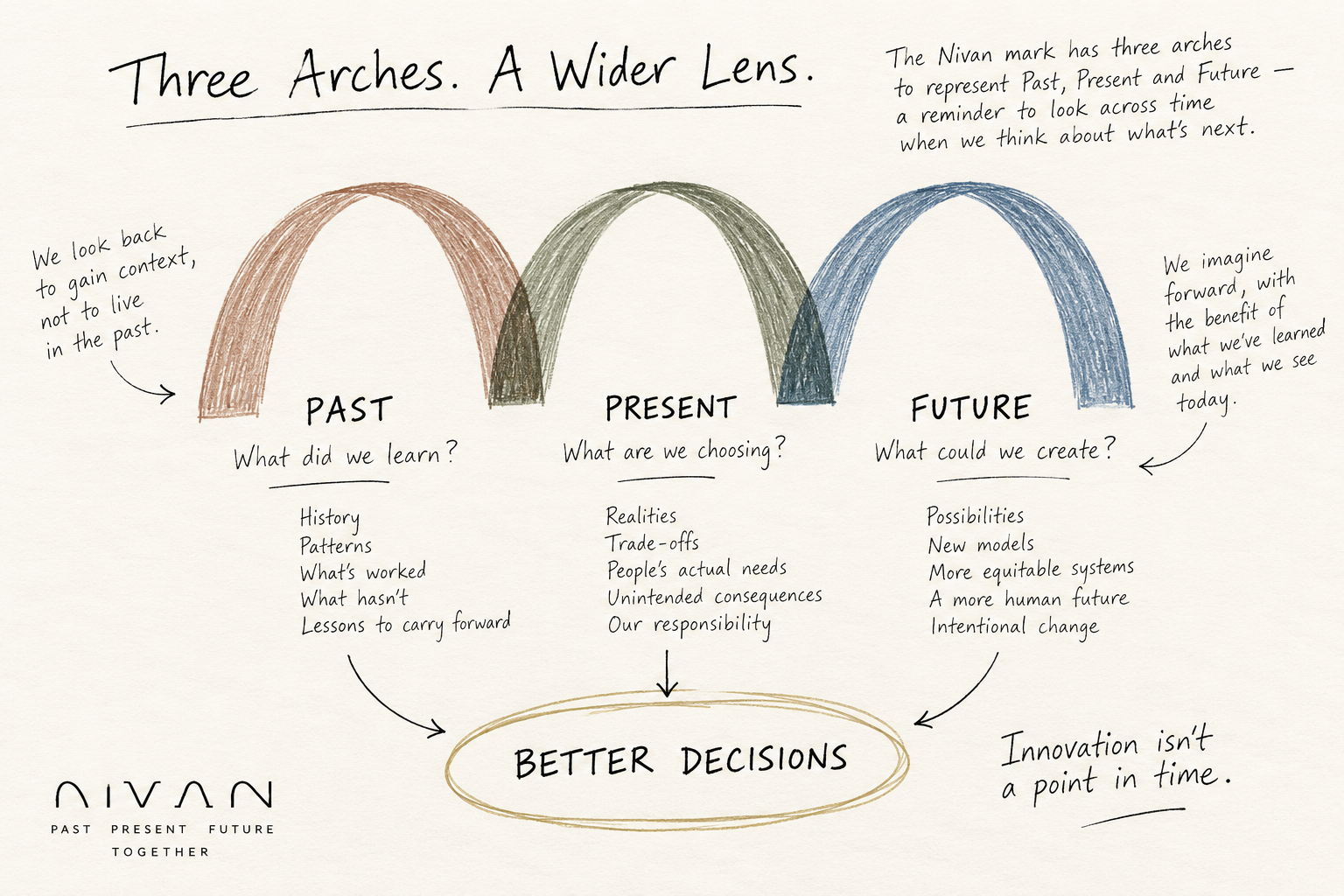
Nivan's three arches represent Past, Present and Future. The framework asks what we can learn from history, what we are choosing today, and what we could create next, bringing all three perspectives together to make better decisions about innovation.
The past is not nostalgia. It is data.
Innovation culture naturally rewards the new. We celebrate disruption, breakthroughs and the people willing to challenge what came before. But when we only look forward, we discard one of the richest sources of insight we have, which is everything humans have already tried. Automation has transformed professions before. New forms of media have changed how we communicate and how we decide what to trust. Technology has repeatedly redistributed access, knowledge, opportunity and power. When you trace this across four distinct eras of human capability, the technologies differ completely and the human questions underneath them barely move. The past is not something innovation needs to escape. It is a dataset.
The present is where responsibility actually lives
The future is exciting because it feels open. The present is harder, because it belongs to us. AI is already shaping how people search, shop, work, learn, create and decide. Researchers are choosing which human signals deserve attention. Designers are choosing how intelligent systems should behave around people. Engineers are choosing what gets automated. Business leaders are choosing what gets optimized. Each of those feels tactical in the moment, and most of them are the decisions we never realize we are making, which together become the architecture of what comes next. The future does not simply arrive. We manufacture pieces of it every day.
The future should be designed, not only predicted
We spend enormous energy trying to predict. What will AI look like in five years, which professions disappear, what emerges next. Prediction has value, but I am far more interested in agency. Instead of asking only what will happen, what if we asked what we want to happen, and then what we are willing to do today to create it? Prediction makes us observers. Agency makes us participants. Everyone building technology right now is already participating, whether or not we admit it.
My research background changes how I curate
This is why my background matters to what Nivan is becoming. I do not approach it primarily as an event organizer. I approach it as a researcher. Research trained me to notice when the first answer is not the real answer. UX trained me to think about a whole experience rather than isolated moments. Years inside technology taught me the difference between a trend that sounds exciting and a problem practitioners are genuinely stuck on. So when I look at a Nivan stage, I am not asking who would be impressive to put there. I am asking what conversation this room needs, who sees this problem differently, which assumption deserves to be challenged, and what happens if I place these two perspectives next to each other.
Why I think of myself as a curator
Founder describes how Nivan started. Curator describes what I actually do. A curator does not simply collect interesting people or ideas. A curator creates meaning through what is placed beside what. At Nivan that means deliberately mixing UX, AI, design, research, technology, business and wildly different industries. It also means paying attention to Cultural Intelligence, because a room that reflects only one context will only ever solve for one context. It means selecting for perspective rather than résumé. It means thinking about how one conversation changes the way you hear the next one. The goal is not to fill a stage. It is to create collisions that would not otherwise have happened.
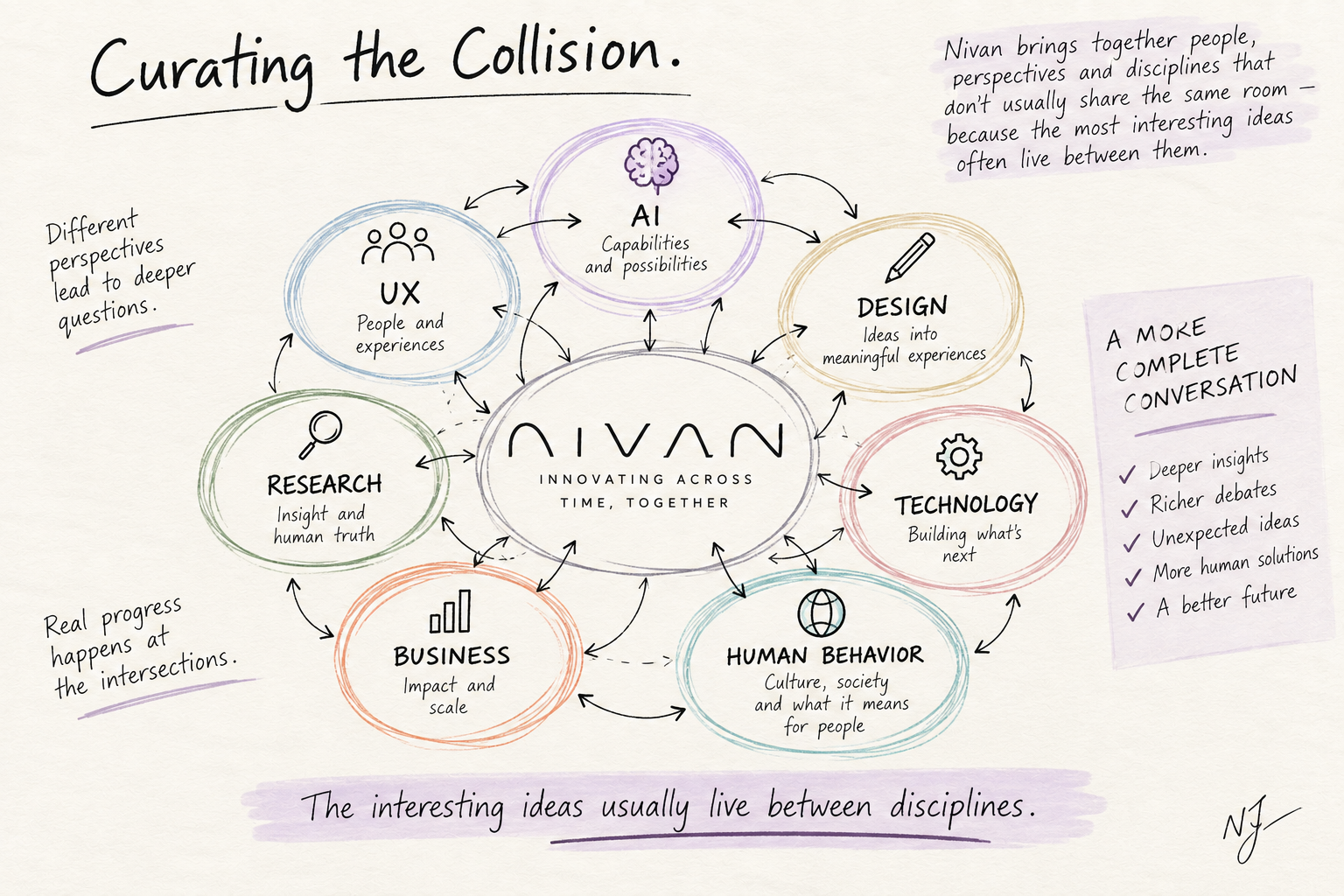
Nivan brings together AI, UX, design, research, technology, business and human behavior in one room, because the most interesting ideas usually live between disciplines.
Past, present and future became more than an agenda
What began as a way to structure one day has become how I think about innovation generally. Looking across time makes the questions better. Instead of only asking what is next, we get to ask what we are carrying forward, what we should leave behind, what history already taught us, what we are failing to notice right now, what future our current decisions are quietly building, and what we should do differently now that we have noticed. It is also how I think about the systems we build, which is what led me to Temporal Alignment, the idea that AI should serve not only who someone was but who they are becoming.
Nivan is the physical form of that idea
At some point I realized I was not really building a conference. I was building a place for a particular kind of thinking. Somewhere history can sit beside emerging technology. Where someone who has spent decades inside an industry can argue with someone trying to reinvent it. Where practitioners can challenge executives. Where genuine optimism about AI can sit in the same room as hard questions about its consequences. And where people do not only consume ideas but help shape them.
Maybe it was always going to look like this
Looking backward now, Nivan feels less like a business idea I discovered and more like a set of things I have always cared about finally finding one home. Curiosity. Human behavior. Technology. Design. People. Unexpected connections. Questions with no obvious answer. My career in research and UX gave me the tools to investigate them. AI raised the stakes. Nivan gave me a canvas wide enough to hold the whole conversation, which is why it is built around innovating across time, together.
Why it is called Nivan
By the time the idea needed a name, the answer was already sitting inside the work. Ni means reflection. Van means motion. When reflection meets motion, Nivan happens. Reflection with no motion is a good conversation that changes nothing. Motion with no reflection is speed with no direction, which is most of what our industry currently rewards. I did not want a name that described an event. I wanted one that described the tension I have been circling my entire career, and the only place I have ever seen better decisions actually get made.
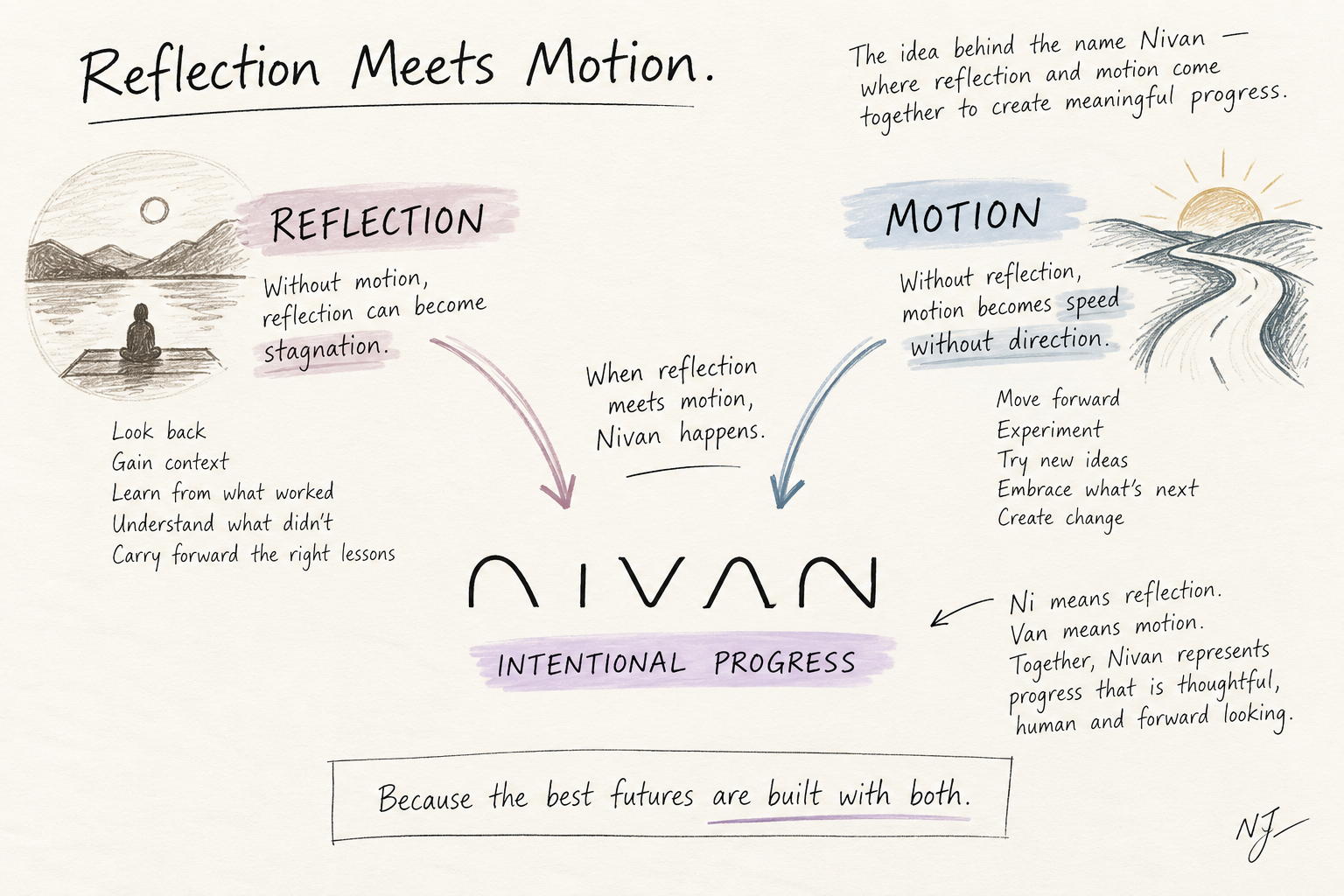
The idea behind the name Nivan. Ni means reflection, Van means motion. Together they represent progress that is thoughtful, human and forward looking.
Through the lens of time
I call this way of thinking Through the Lens of Time Travel: examining innovation across past, present and future so we can make better decisions about what comes next. It runs through my writing, my talks and the experiences we build at Nivan. The future deserves imagination. Imagination simply becomes far more powerful when it has context.
The question I want Nivan to keep asking
Technology will keep changing. Today's breakthroughs become tomorrow's assumptions, and the AI capabilities that impress us now will feel ordinary sooner than we expect. But there is one question I hope outlives every technology cycle at Nivan. If we understand where we came from, pay attention to what we are choosing now, and take responsibility for where we are going, can we build a better future? I believe we can. To see further ahead, sometimes we have to look across time.
Niketa Jhaveri is a UX and research leader, international speaker, and Founder and Curator of Nivan. For more than two decades she has worked at the intersection of human behavior, design, technology and emerging AI, leading global research for AI powered products. Her essay series Through the Lens of Time Travel examines innovation across past, present and future, and introduced the frameworks Deliberation Debt, Temporal Alignment and Cultural Intelligence.