
AI Would Have Designed a Minivan With One Door
Bob Nesbitt spent six and a half years at Eli Lilly leading the team that decided what delivery devices future therapies would need, and a decade at AbbVie across human factors and portfolio strategy. His Nivan Live session used two products, an auto injector and a minivan, to make the sharpest evidence based case of the day for a single claim: AI is a powerful tool for innovation and it cannot be used alone..
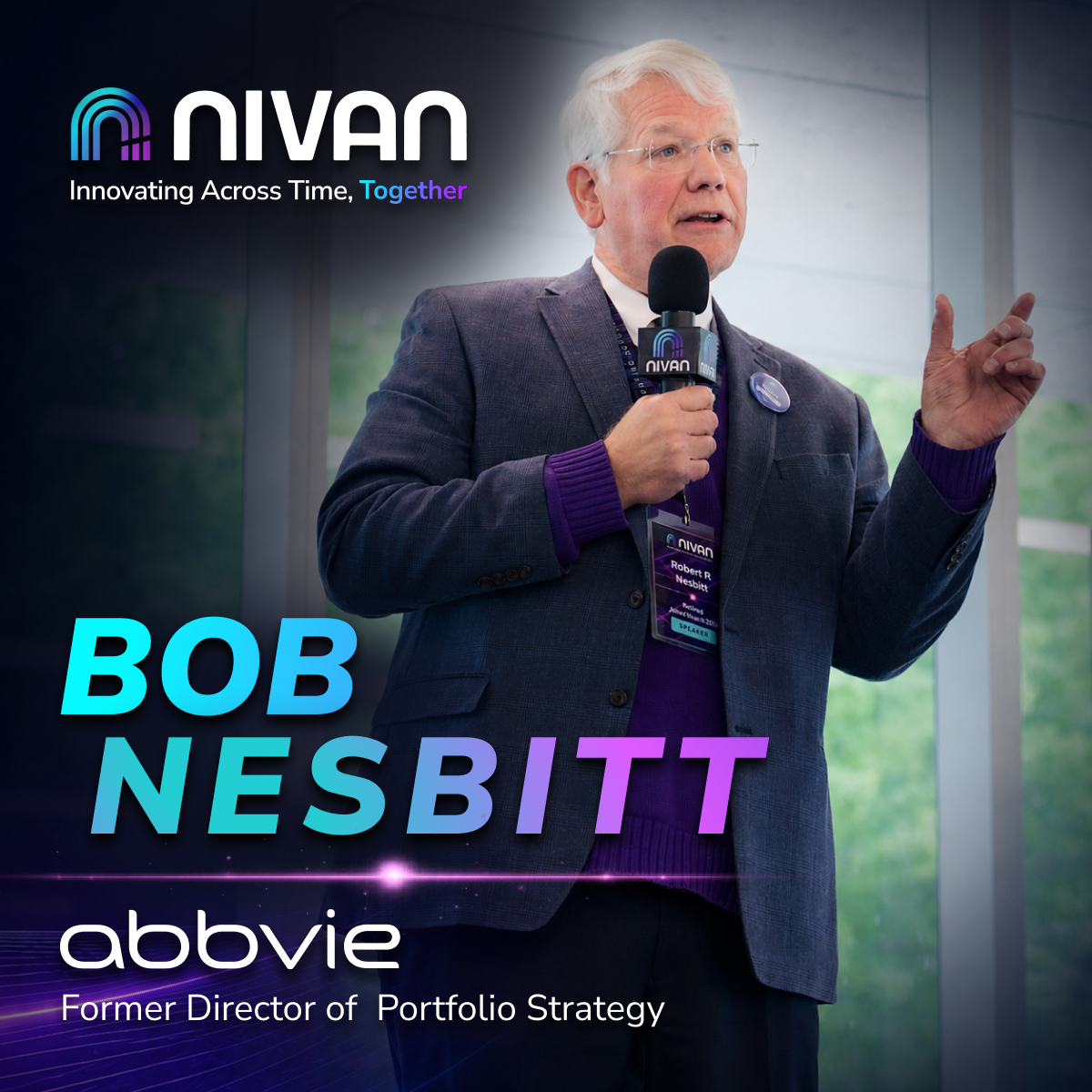
Bob Nesbitt at Nivan 2026
The team that had to see four years ahead
Bob led the incubator group inside Lilly's delivery device organisation. Its charter was to look at what sat in phase two clinical development, identify which therapies could not be delivered in pill form, and determine what device patients would need four to six years later when those drugs emerged from phase three. That meant understanding the disease, working with endocrinologists and rheumatologists, and coordinating with marketing, market research, manufacturing and clinical teams.
Why the business hesitated
Device makers license intellectual property to a pharmaceutical partner for a specific drug and a specific disease state. Committing meant years of prototyping and clinical build costs for therapies that might never clear phase two. The internal answer was reasonable caution: hold on, we are not ready to sign. So the team went out to learn what patients actually needed from devices already on the market before anyone signed anything.
The cross functional group that was each right and each wrong
Bob was direct about his own bias. His engineers assumed marketing would tell them what to want and that market research would arrive with data. What he found instead was that every function held a piece of the truth and none held it whole. The value came from putting all of them in the same room, then sending them out together to watch patients rather than to talk at them.
A cylinder that rolls off a table
Almost every auto injector on the market was a cylinder. Set one down on a desk and it falls on its side. That sounds trivial until you consider advanced rheumatoid arthritis, where grip strength and dexterity are limited and picking a small object off a flat surface is genuinely hard. Worse, a cylinder rolls onto the floor, and if the needle shield is already off, the contaminated end is what goes against the body.
The lesson that came from epinephrine
The hardest learning came from outside chronic disease, from parents of children with nut allergies and from the epinephrine market. With a cylinder, a first time user under pressure often cannot tell which end the needle comes from. Done correctly the drug reaches the patient. Done incorrectly the drug goes into the thumb of the adult holding it, and a child on the ground receives nothing at all.
Why the device is shaped the way it is
The trilobular form was not a stylistic decision. It stands on a desk rather than rolling. It sits in the crevice between thumb and hand so the cap can be turned off instead of pulled off, using a small triangular ramp that pushes the cap away as it rotates. Every one of those details answered something observed in a patient's home, with appropriate privacy protection, through a design partner who recruited across multiple disease states.
The word that changed the internal mechanism
Engineers assumed the sequence was simple: remove the shield, press it on the skin, and the device does the rest. Patients used a different word. To trigger the mechanism they had to push hard enough that they described it as stabbing themselves. That single word led to redesigning the internals so the device would not actuate when placed gently on the skin and would fire only when a button released it. A small engineering change and an enormous psychological one.
The minivan test
Bob then asked the room to raise hands if their minivan had a passenger door on each side. Every hand stayed up. That was not always true. Chrysler owned the category from 1984 through the mid nineties with one door on one side, adding luxury features rather than access. Forty years of history said a minivan has one passenger door.
What a model trained on that history would have concluded
This is the centre of his argument. AI did not exist in 1995, but had it existed and been asked what a minivan is, four decades of evidence would have told it that a minivan has a single passenger door. The second sliding door in 1996 was not a technology breakthrough. It came from engineers, marketers and brand teams travelling with families and watching how hard it is to buckle a child into the far seat.
The temptation Bob names honestly
He was clear that his managers at the time would have questioned the cost of sending teams into the field, and that the same managers today would point at Claude and ask whether an innovative product could be produced without all that travel. He did not dismiss the tool. His position is that AI has real value and must be grounded in two things: what users actually do in the market, and a cross functional team willing to set aside its correct but incorrect assumptions.
The message underneath the case studies
Both stories are told as product histories and neither is really about the product. Bob was explicit that the how matters more than the what. Go where the users are, bring every function with you, and stop talking long enough to watch. That is transferable to any industry, and it is the part no model can perform on your behalf.
