
Show Me the Breadcrumbs Back to the Real Problem
Tony Bynum is faculty at the Institute of Design at Illinois Tech and directs its Executive Academy. He is not a trained designer, which is precisely why his Nivan Live session works. He offered a structured, repeatable way to move into an uncertain future, four questions anyone can ask regardless of role, and a diagnostic for where organisations actually break.
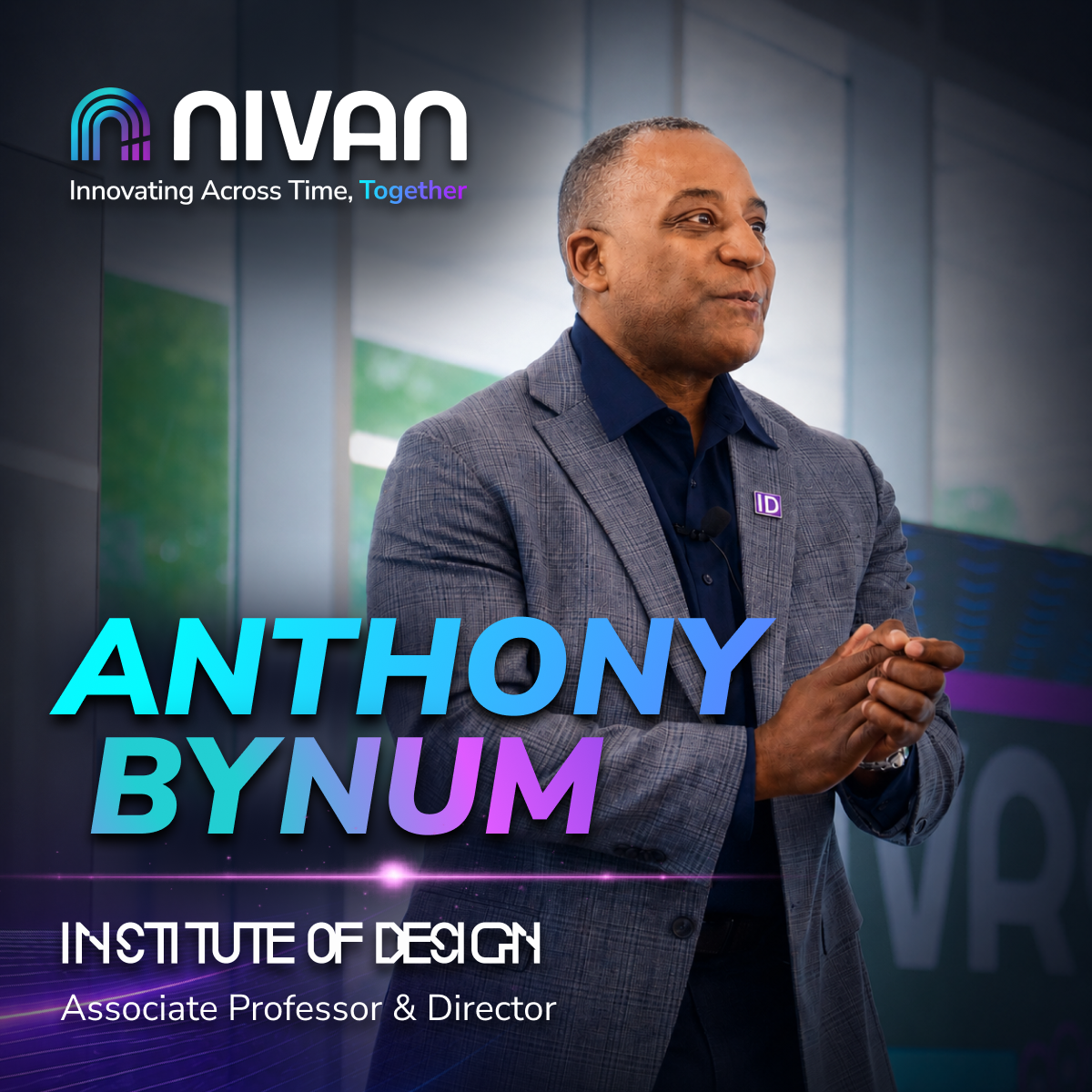
Tony Bynum at Nivan 2026
Arriving as a sceptic
Tony came to the Institute of Design in the early two thousands holding an MBA and initially found the place incomprehensible. About a month in, two things resolved at once. Organisations need a structured, repeatable way to solve problems, and design needs difficult human and systems problems to solve. He has straddled those two worlds since, and the Executive Academy exists to carry the school's teaching inside the walls of a company without the academic apparatus.
Two things always happening at once
The model begins with an observation rather than a method. In any hard problem there is the activity you and your team are engaged in, and there is the information you are using or creating while you do it. Mapping those two dimensions produces the entire framework, which is why it holds regardless of industry or vocabulary.
The two spectrums
The activity spectrum runs from understanding or knowing something at one end to making or doing something at the other. The information spectrum runs from very abstract to very real and factual. Four quadrants follow, and Tony walked them in order rather than presenting them as a finished diagram.
Box one, research
Understanding what is real is research, and what comes out of it is facts and findings. He was strict about the definition. Facts and findings are empirical. They carry no opinion and no assumption. They are what was seen, said, heard or done, and nothing else belongs in that box.
Box two, sense making
Understanding what is abstract is analysis, which Tony prefers to call sense making, and what comes out of it is insights. He connected this directly to the insights theater problem raised earlier in the day. Organisations routinely present facts as insights, or present credible analyst reports as insights, and those are different things. The goal is a proprietary insight, meaning two competitors can observe the same market event and interpret it differently because of their brand, strategy and capabilities. It is not about being right, it is about being clear.
Box three, and the question that stops a room
Making something abstract is synthesis, or ideation, or brainstorming. This is where most teams begin, jumping straight to box three when someone asks for the next new thing. Tony's response as a faculty member and as someone deciding whether to fund work is to ask for the breadcrumbs back to the real problem. Hunches and guesses are fine. They are simply not solutions, and without a trail back to evidence you are investing in one.
Box four, and what prototypes are for
Making something real is prototyping. Two failures recur. Teams throw the prototype over a fence to people who were not part of the process, and intent is lost. Or teams take a first run prototype, call it a minimum viable product, and test it against finished product conditions, where it fails. Tony also advised against photorealistic early prototypes, because the feedback becomes button colour and screen placement rather than whether the right problem is being solved.
Confidence loops
Each pass through the loop, and there may be several depending on complexity, is a confidence loop. Its function is to let a team return to the organisation and say either that this should proceed or, just as valuably, that it should be killed. This is the sentence to carry into a boardroom. Design is a way to de risk change inside an organisation.
The four provocations
For anyone who does not want to use the word design, Tony reduced the model to four questions in order. What is. What does it mean. What is possible. How does it work. Follow those and you are doing design regardless of your job title. He also noted, with a nod to the host, that moving from why to what is roughly the movement inside the name Nivan itself.
Play chords, not notes
A mentor's phrase became his instruction for box three. A single point solution is a note. Knitting concepts into systems is a chord. Everybody has words, he said, and the work is creating your own sentences from the ownable space established in box two. That is where differentiation lives rather than in the newness of any individual idea.
Where organisations actually break
He then walked the transitions as a diagnostic. From box one to two, the question is whether you are sensing change accurately, and the symptoms are competitors surprising you more than you surprise them, defaulting to what the data says instead of what you believe, and change seeming to happen to you. From two to three, the capability is converting a point of view into balanced strategic bets, and the symptom is being described in the same words as your competitors. From three to four, the capability is turning concepts into systems, and the diagnostic is whether customers experience your offering as transactional or relational, and what the fiftieth interaction feels like.
Humility as the next capability
Closing the loop back into empathy is about building a culture of experimentation, and here Tony offered the line most worth carrying out of the room. Designers talk constantly about empathy, but humility is the capability the next period demands. The problems are too complex for anything else. Humility is what opens curiosity, and it is what lets a practitioner stand in front of something they do not understand and lean into it rather than away.
