
Creative Duel: Personalization versus Privacy
The final Creative Duel of Nivan Live 2026 sent Sarah Wallace of Proprietary Insights against Eric Smallwood, formerly director of design at Walmart, on the question the future portal had been circling all afternoon. Both defended their side with conviction rather than theatrics, and it produced the only clear audience verdict of the day.
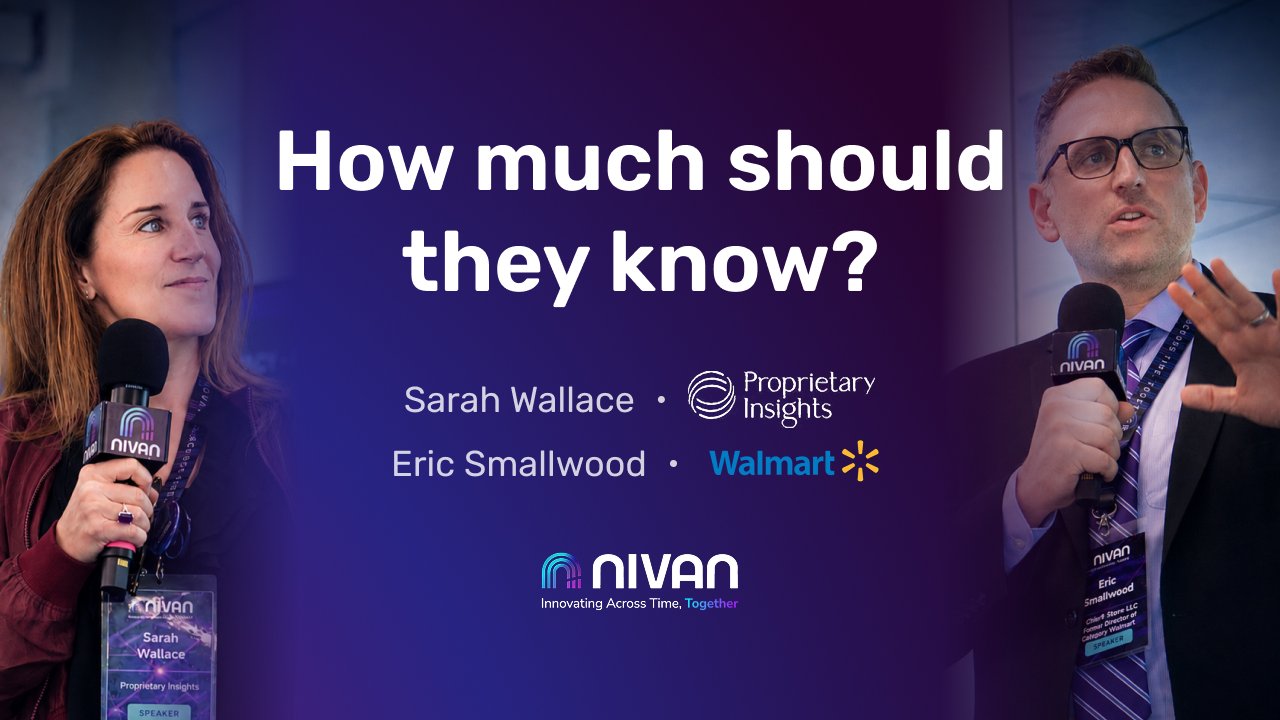
Sarah Wallace and Eric Smallwood at Nivan 2026
Defining the terms before arguing
Eric insisted on definitions first, which shaped everything after. Privacy is the ability to be free from observation or monitoring. Personalization is the ability or desire to design towards an individual's specifications. Establishing that separation mattered, because most of the disagreement in this field comes from treating the two words as opposite ends of one scale rather than as different categories of thing.
The question that set the foundation
He then asked a room of experienced practitioners how many felt free from being monitored on a daily basis. One hand went up and he refused to believe it. These are the people who build these systems, and they do not experience the condition his own definition describes. That single show of hands did more work than any statistic in the session.
The relationship neither of them could settle
The unresolved core is whether personalization and data monetisation can be separated. Sarah declined the equivalence directly, saying she is not a proponent of taking people's data and selling it but of using personalization to improve experience. Eric made the structural objection. The degree to which any company allows you to personalize is directly related to what it can do with the data that personalization generates, which means the two cannot be disentangled and the guardrails are consistently drawn to favour the company. Neither moved, and the audience had to choose between them.
The case for personalization, argued by Sarah Wallace
Sarah argued from economics and ethics simultaneously. Customers want to be known, and being known is what people actually seek from the brands they choose. Her evidence was blunt. Thirty two percent of customers will leave a brand they love after a single bad experience, climbing towards fifty nine percent after two. Not an indifferent brand, a loved one. If treating a loyal customer as an anonymous record qualifies as a bad experience, the cost of refusing personalization is churn rather than theory. Her line about it was the one the room remembered. Generic is not neutral. Every interaction is a contribution, and doing nothing with what someone gave you is itself a message.
Relevance as the source of trust
Asked whether relevance in the moment or trust over time matters more, Sarah chose relevance and argued the two are causally linked rather than opposed. Relevance in the moment is what produces trust over time. A hotel that knows she prefers a higher floor and a softer pillow has turned a transaction into a relationship, and having to restate the same preferences at every check in raises a reasonable question about whether anyone is listening. She also acknowledged, without being pressed, that legislation has a role, particularly where children and unread terms are concerned.
The case for privacy, argued by Eric Smallwood
Eric's strongest material was historical. Privacy was once simply the default, and nobody had to consider whether it was being pierced because neither the technology nor the commercial incentive existed. Over roughly twenty years that default inverted and no one was asked to approve the change. His counter to the hotel example was efficient. Knowing your preferred pillow builds trust, and selling that preference onward so pillow advertising follows you destroys the same trust the first act created. The mechanism that produced the good outcome produced the bad one, which is his inseparability argument in a single image.
Consent as a design problem
Rather than complain, Eric handed the room work. Designers are demonstrably capable of communicating how data will be used far better than a contract nobody reads, even where the contract still has to be signed. He drew a useful gradient from research, noting people are relatively untroubled by site visits or purchase preferences and grow sharply uncomfortable as usage moves further from the original interaction. That gradient is designable, and treating privacy as one binary setting ignores it. He also put the uncomfortable question directly to the practitioners, asking whether the company they work for is willing to pay the cost of doing this properly, and whether that should simply be accepted.
The quadrant nobody has built
The two presented a simple two by two. One corner is the fortress, complete privacy and therefore no personalization. Eric's assessment is that the industry sits well inside the risk zone at the opposite side. The upper right corner, where trust and personalization coexist, is the one he argued nobody in the room has actually seen built, and Sarah did not contest it. That shared admission is the most useful output of the session, because it identifies an open space rather than a settled argument.
What the room decided
For the first and only time that day, the audience produced a clear result. Eric won on privacy. The moderator called it without hedging. Worth noting is that this verdict came from a room of practitioners who spend their working lives building personalized experiences, which makes it a statement about their own products rather than a preference expressed as consumers. That is the finding, and it should trouble anyone shipping personalization features.
Questions this leaves open
If a room of people who build these systems votes for privacy, what does that say about the products they will ship on Monday. Sarah is right that customers leave brands that treat them as strangers, and Eric is right that the empty quadrant remains empty, so which of your current features would survive genuine informed consent presented clearly rather than buried. If informed consent is a design problem, as Eric argued, why has no company solved it, and is the reason technical or commercial. And if the exchange is transactional, as Sarah framed it, what exactly did your customers agree to receive in return, and are you delivering it.
The formulation both sides could live with
Eric's closing line carried the room. Personalization is a tool and privacy is a right. He was careful that this does not mean personalization should not exist, only that it has to be checked by a real commitment to the right underneath it. Sarah's closing pointed at a designer in the room who had redesigned one of the most opaque documents an ordinary person encounters, and argued that the profession is plainly capable of making difficult ideas clear. Taken together they describe the same unbuilt product, which is a personalized experience a person could understand well enough to genuinely consent to.
