A New Framework for AI in Consumer Health
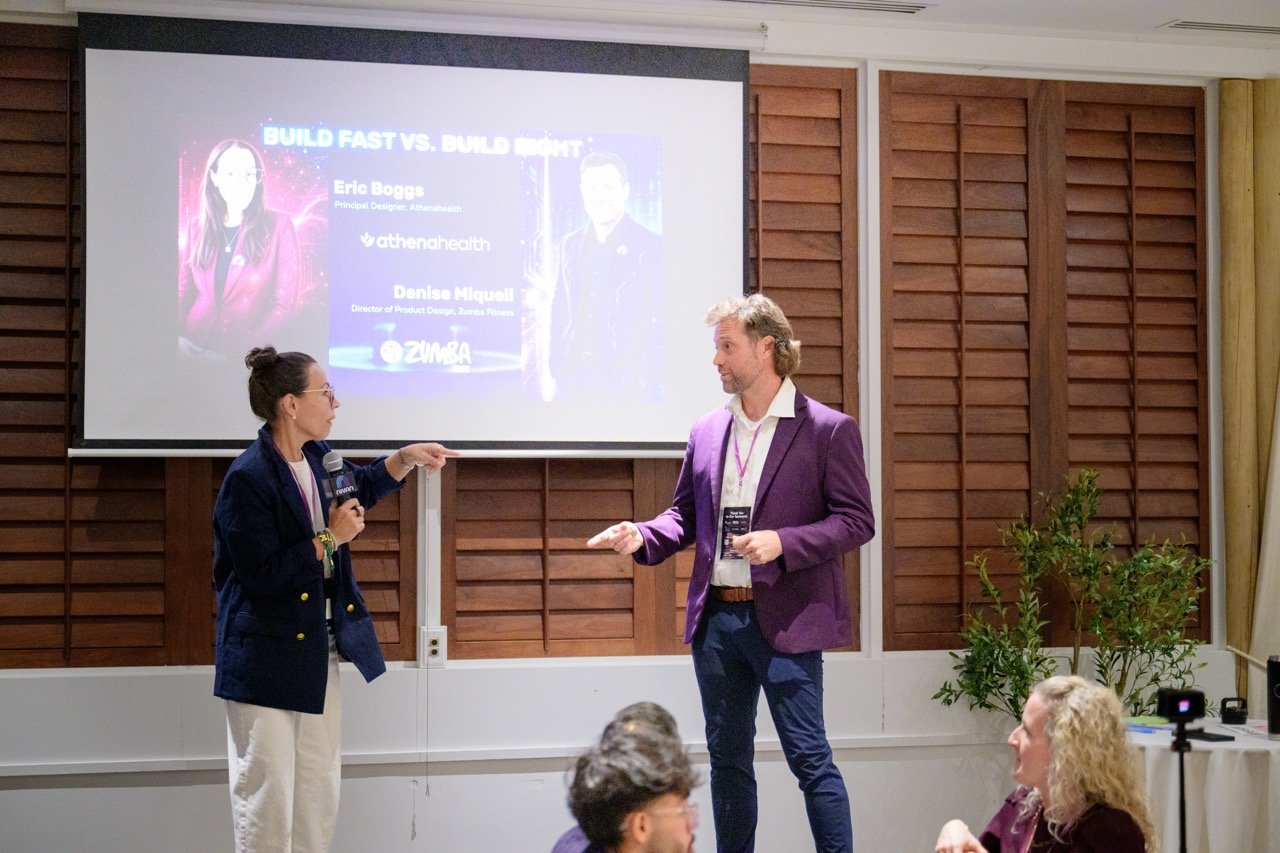
By Denise Miqueli and Eric Boggs, NBC-HWC
Why we wrote this
If you design health technology, you’ve heard a lot about AI lately. Use it for this, use it for that - but mostly in the spirit of moving faster. Work is changing, so keep up. Most of that advice comes from the outside in, and a lot of us have been reacting to it.
We think there’s a better question to start with. How might AI actually improve health outcomes?
That isn’t a new question. For decades, researchers have studied why people change their health behavior. The Health Belief Model looks at how we weigh risk. Albert Bandura showed that believing you can do something drives whether you do it. The ecological model zooms out to family, community, and policy. These ideas still hold up. They just weren’t built with technology in mind, or for the people building products.
We don’t want to replace them. We want to build on them.
We come at this from two directions. Denise directs product design and research at Zumba Fitness, where she studies what keeps 15M+ people around the world coming back to class every week. Her team has built AI into both how they work and what they ship. Eric has spent more than 12 years designing healthcare experiences and is a board-certified health and wellness coach. Between us, we’ve watched what happens when people get good information. We’ve also watched what happens next, which is usually the harder part.
Across the research, and in our own work, three things keep showing up when change lasts:
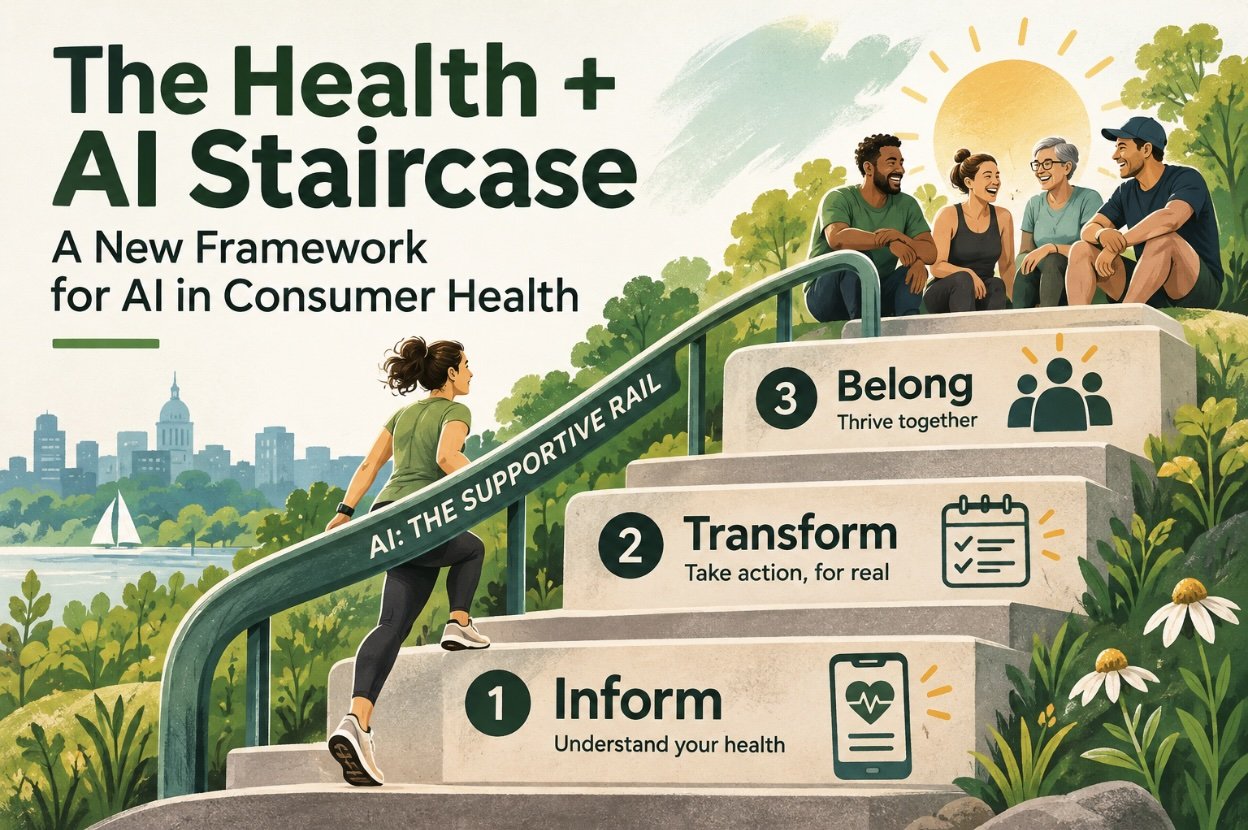
Inform. You know what’s going on with your health and what it means for you.
Transform. You act on it, again and again, with the support of people and systems around you.
Belong. You become part of a community that sustains change whenmotivation fades.
Each is a precursor for the one after it. And if we want to improve health outcomes at scale with AI, it’s essential that we recognize and adapt the role that AI can play at each stage.
We call this framework the Health + AI Staircase: Inform, Transform, Belong.
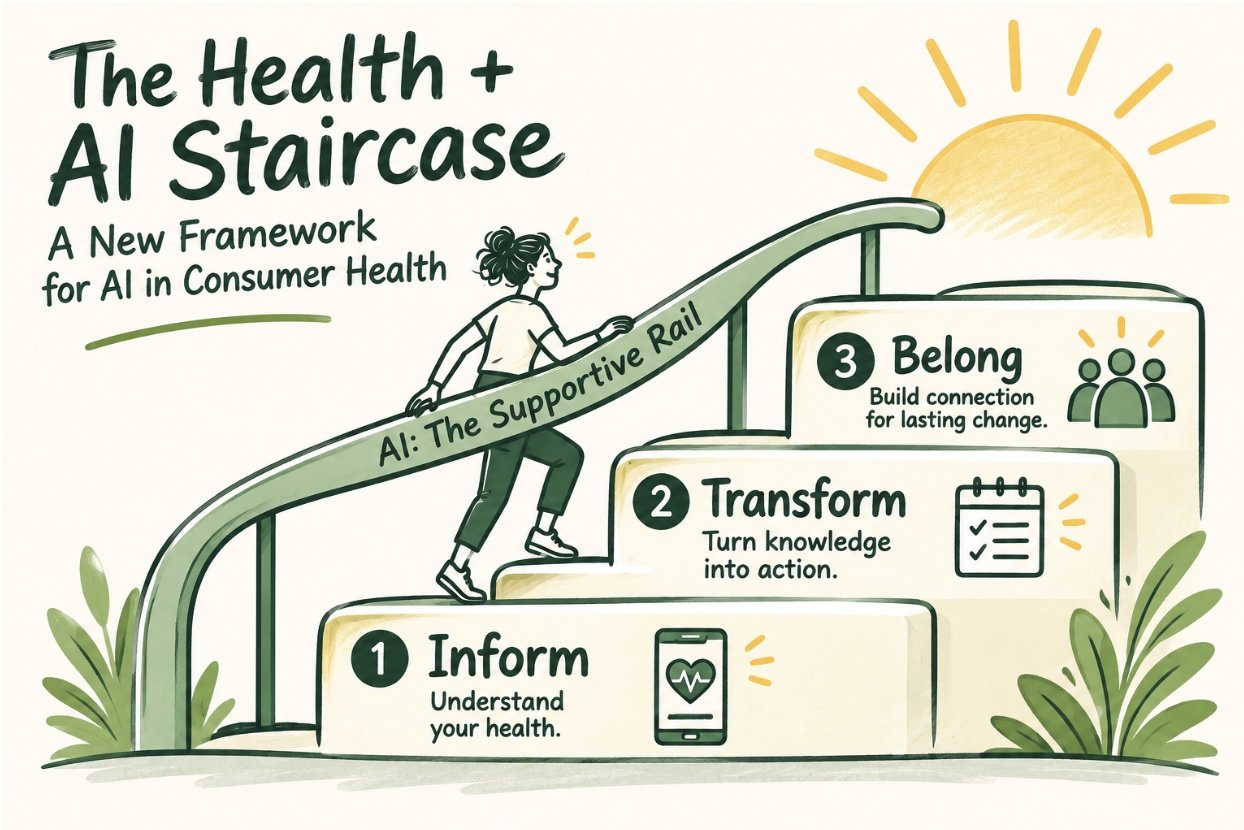
AI belongs on every step. Not as the staircase, and not as the one climbing. AI is the railing, something to grab so you can climb yourself. What the railing does changes as you go. On the first step, it explains. On the second, it helps you act. On the third, it brings you closer to the people who keep you climbing.
Today, most AI in health stops at the first step. This framework is about what comes next.
Level 1: Inform
Denise
Nobody hands you a manual when you become a parent. Should I give him Tylenol or Motrin? Which immunizations will give him a fever? Can I wait it out, or is it time to call the doctor?
As a new mom, I kept impeccable notes and recorded every appointment, but I still felt embarrassingly unprepared for the mildest symptoms.
Until Claude became my son’s record keeper. His medical history, allergy triggers, medication logs, and diagnoses, all in one place. For the first time, I could see the full picture. I felt empowered.
Now, you’re probably thinking, “Is she entrusting her son’s health to an AI?”
Relax. I’m not letting a chatbot raise my kid. Claude didn’t decide anything for me. It helped me walk into the pediatrician’s office with better questions, and walk out understanding the answers. The doctor still made the call. I just stopped panic-Googling at 2 a.m.
Eric
I’ve had my own version of this. Some lab results came back, and I had simple questions. What do these numbers mean for me? I sent them through the patient portal. The answer was to book a specialist. The earliest opening was more than six weeks out.
So I asked AI. Within minutes, I understood my results well enough to stop worrying. Six weeks of stress, avoided.
This is where AI is strongest today. “Googling your symptoms” has become something closer to a conversation. It’s personal. It remembers context from past conversations. You can even tell it how to talk to you, including “don’t sugarcoat it.”
You’ve probably already seen AI:
Remove bottlenecks to getting information
Make sense of complex results
Explain things in a way that fits you
Remember context from past conversations
Replace visits that were only ever an exchange of information
Act as a thought partner on health decisions
As a builder, ask yourself: How else could I help people understand their health?
Level 2: Transform
Eric
Information is essential, but it doesn’t guarantee change.
Most of us already know what’s good for us. Move more. Eat more vegetables. Sleep. Manage stress. But it’s incredibly hard to change. According to the CDC, chronic diseases cause 7 in 10 deaths each year, and most preventable ones are caused by a short list of behaviors: smoking, poor diet, inactivity, and excess alcohol.
We don’t live in an ideal world. Priorities compete. We put others first: family, work, community. Our surroundings do a lot of the deciding for us. The rest comes from behaviors, social and economic conditions, and physical environment. Then there’s how we feel. Rested and steady, we make better choices. Exhausted or stuck in negative thoughts, the quick reward wins. That’s not a character flaw. It’s how people work.
This is where the railing needs to do more than explain. So far, we’ve seen early examples of AI being proactive: reminders, a nudge to prepare before an appointment. It’s a start. The opportunity is much bigger:
Reach out first, instead of waiting to be asked
Help people see and change their surroundings
Support the changes people say they want, not the ones a product wants
Anticipate physical and emotional needs, possibly from real-time health data
As a builder, ask yourself: After someone learns something new about their health, what does my product do over the next week?
As a coach, I have to add that not everyone is going to want, or be able to, grab the supportive rail of technology wholeheartedly. Transformation is deeply personal and human-centered. We must make sure the right humans and coaches are connected to listen, and foster change in accordance with care plans and individual needs. AI can support this triage.
Level 3: Belong
Denise
Here’s the thing about Zumba that nobody warns you about: you show up for the workout, and you leave with a best friend. We have wild transformation stories, and almost none of them are about the salsa steps. They’re about the people. You start recognizing faces. You notice when someone’s missing. Then you meet a total stranger who also does Zumba, and boom, instant bond, like you share a secret handshake.
Community isn’t a nice-to-have. It’s what keeps people climbing, and it’s the step where AI still loses its footing. Read any roundup of AI fitness tools and you’ll find smart rings, smart mirrors, and apps that adjust your reps in real time. Wearables can flag that something’s off, but figuring out what to do about it is still on you. What you won’t find is the friend who texts you “you coming tonight?” One runner in JMIR’s “Should AI Be Your Personal Trainer?” credited 4 years of consistency to accountability and trust with one trainer, not to a tool.
We’ve tried to build this online. Gamification, forums, comments under videos. Here’s what we learned: opening up to a room of people you can high-five is one thing. Opening up to a row of anonymous usernames is another. Accountability is the real unlock, and accountability needs connection first.
So what worked? Letting people bring a friend. We piloted “send your goal to a friend,” where someone you actually know gets updates on your workouts. When a real person is watching, you show up. It works. Scaling it is the hard part.
AI could help match people up, but pairing strangers loses some of the magic. On this step, AI is still the railing, not the friend. It helps you reach the people who keep you going. Which brings me to my one rule for builders: be transparent. People will trust AI for guidance. They won’t thank you for faking a friendship.
As a builder, ask yourself: How could my product bring people closer together, without pretending to be one of them?
What this means for people building health tech
On every step, AI is the supportive railing. It explains. It helps you act. It brings you closer to your people. That’s the staircase in one breath.
Right now, most of the innovation is piled up on the first step. AI is great at answering the 2 a.m. question, explaining the lab result, and making sense of the data. That matters. It’s already changing how people take care of themselves and the people they love.
But knowing isn’t doing, and doing isn’t sticking. The next stage of innovation lives higher up the staircase. That means tools that help people act on what they know, day after day, in the middle of real life. And it means tools that bring the right people closer together instead of trying to replace them.
So look at your own product. Where does AI show up today? Which step is it on? And what would it take to help your users inform, transform, and belong?
We’d love to hear where you agree, where you don’t, and what we’re missing.