
Too Quiet the AI Gets Missed, Too Loud the Patient Does
Kevin Yuda is a senior director of user experience at GE Healthcare, where he leads the design system team and the visualisation of AI across the enterprise. His Nivan Live session made the narrowest and highest stakes argument of the day. In a room with a patient and a clinician, AI is now a third presence, and how that presence is designed is a patient safety decision rather than an aesthetic one.
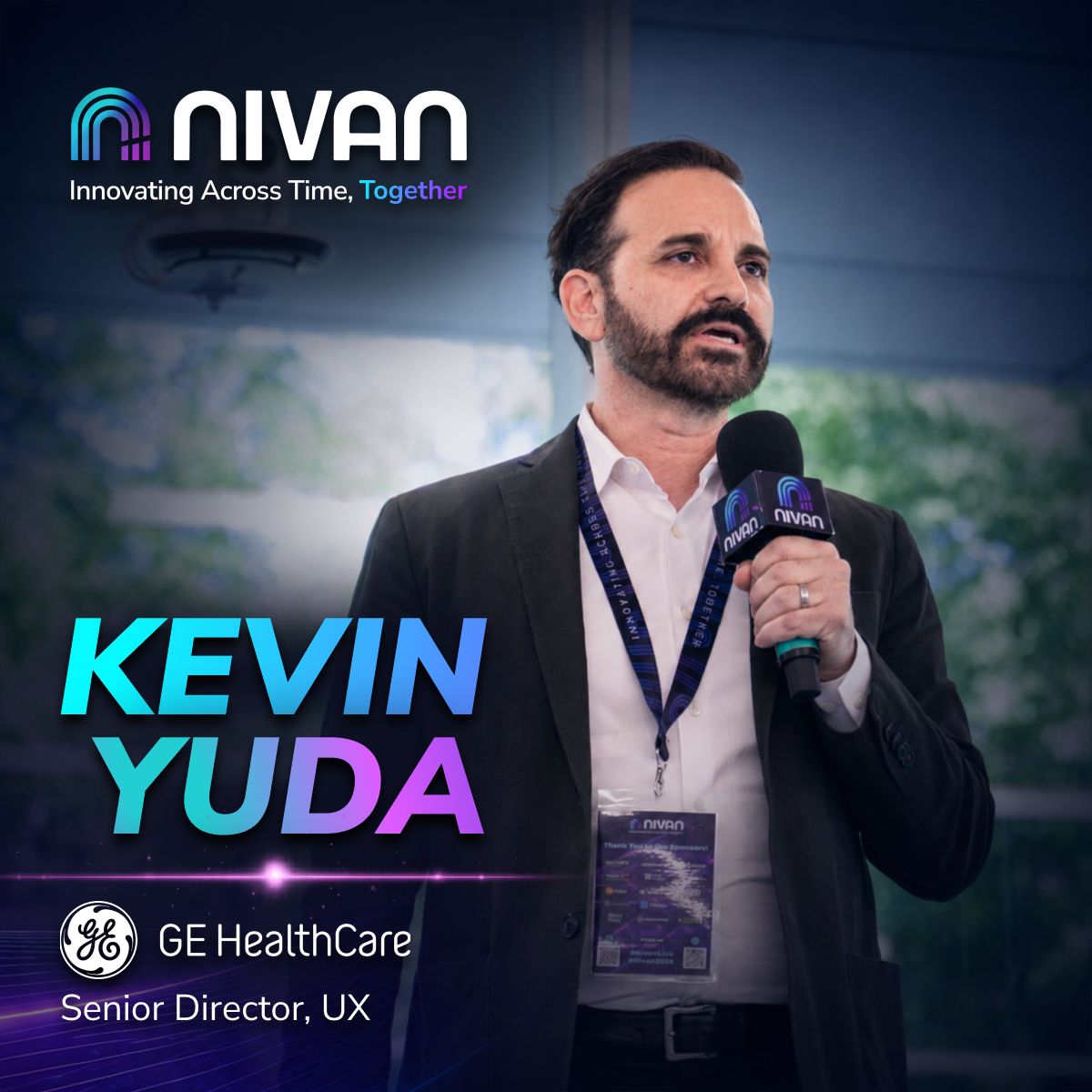
Kevin Yuda at Nivan 2026
Three actors where there used to be two
Kevin's opening image was deliberately plain. A patient arrives for an examination, a clinician captures an image, and AI runs on that image. There are now three actors in the room. He rejected the standard framing that AI is a tool and argued it is a presence, and a presence either earns its place in the room or breaks it.
What a radiologist is actually doing
To understand the design problem you have to understand the task. A radiologist scrolls three hundred fifty slices at speed, holding a mental model of the anatomy, looking for what does not belong. AI runs on those slices and produces a finding. Every design decision lands inside that flow, which has almost no spare attention available.
Failure one, too quiet
In early research using a think aloud protocol, participants were asked whether they could identify the AI. Even after prompting, nobody could. That result sent the team back to iterate. An AI contribution the clinician never notices is not a neutral outcome, because the clinician then misses whatever the AI saw.
Failure two, too loud
The opposite failure is more insidious because it looks like diligence. Pathology obscured by an overlay. An annotation pulling the eye away from something the AI did not flag. A popover mid read demanding acknowledgement. At that point the AI has become the work rather than a contribution to it, and the clinician misses what the AI did not see.
Why both are patient safety failures
This is the sentence that reframes the whole discipline. One failure misses what the AI saw and the other misses what the AI did not, and both are safety failures. Kevin's related formulation, which he acknowledged sounds like a slogan and insisted is a design constraint, is that AI will not replace clinicians but badly designed AI will exhaust them, and when the clinician is exhausted the patient pays.
They stopped declaring trust
The first of three changes in approach was to stop asserting trustworthiness. Saying something is trustworthy accomplishes nothing. Trust has to be designed purposefully, and it accumulates as the cumulative result of many small interactions between a person and the system. That reverses the usual order, in which trust is claimed in marketing and hoped for in use.
Handoffs as the unit of trust
The second change was to treat each handoff as the unit. Every time the AI produces a finding, and every time the clinician goes back to interrogate it, trust is either built or eroded. Kevin's phrasing was that there is no neutral handoff, which gives design teams a countable surface to work on rather than an abstraction.
Choosing a symbol rather than inventing one
The team needed a way for clinicians to identify AI in their workflow, addressing the under salience failure. Rather than invent a symbol, they examined what an entire industry had converged on and found the starburst or sparkle used across Google, Miro, Figma, Adobe and Zoom. By the time AI reaches a radiologist, that vocabulary has already been learned elsewhere. Inventing something new would require learning it twice.
A larger star and a smaller one
Within that category they made a specific choice. The mark is a dual star, one larger and one smaller, distinct and offset. The larger represents the AI and the smaller represents the human. They are paired and not merged. Kevin acknowledged this asks a great deal of an icon, and argued the philosophy has to live where the work lives, which is exactly where the icon appears.
What did not work
He was unusually candid about failures. Popovers appeared each time a clinician deviated from the AI suggestion, and clinicians did not describe that as helpful, they described it as persuasive. The team's stated aim is transparency rather than persuasion, so the pattern was removed. Text labelling also failed. People could see that something was labelled as AI and still did not understand what the AI meant by it.
What he did not know yet
Asked how the exhaustion threshold is measured, and how a nuanced internal state like trust is quantified, Kevin answered both times that he does not have an answer yet. He described the accessibility and colour testing done so far, and the practical constraint that healthcare screens carry enormous content density with almost no white space, so colour quickly overpowers. That honesty is what makes the rest of the session credible.
The question to leave with
Most conversations about AI concern capability, what it can do and what it will do next. Kevin proposed a different one. When AI arrives in a room with a patient and a clinician, will it earn its place. That question is not answered by the model. It is answered by every choice the people designing it made before the patient walked through the door.
