
Your Data Cannot See the Future
Ashley Craig leads research and product innovation at AnswerLab. Her Nivan Live session closed the future portal with an argument aimed squarely at product leadership. The word data has quietly narrowed to mean one kind of evidence, that narrowing became structural, and it happened just as the industry entered a moment that requires invention rather than optimisation.
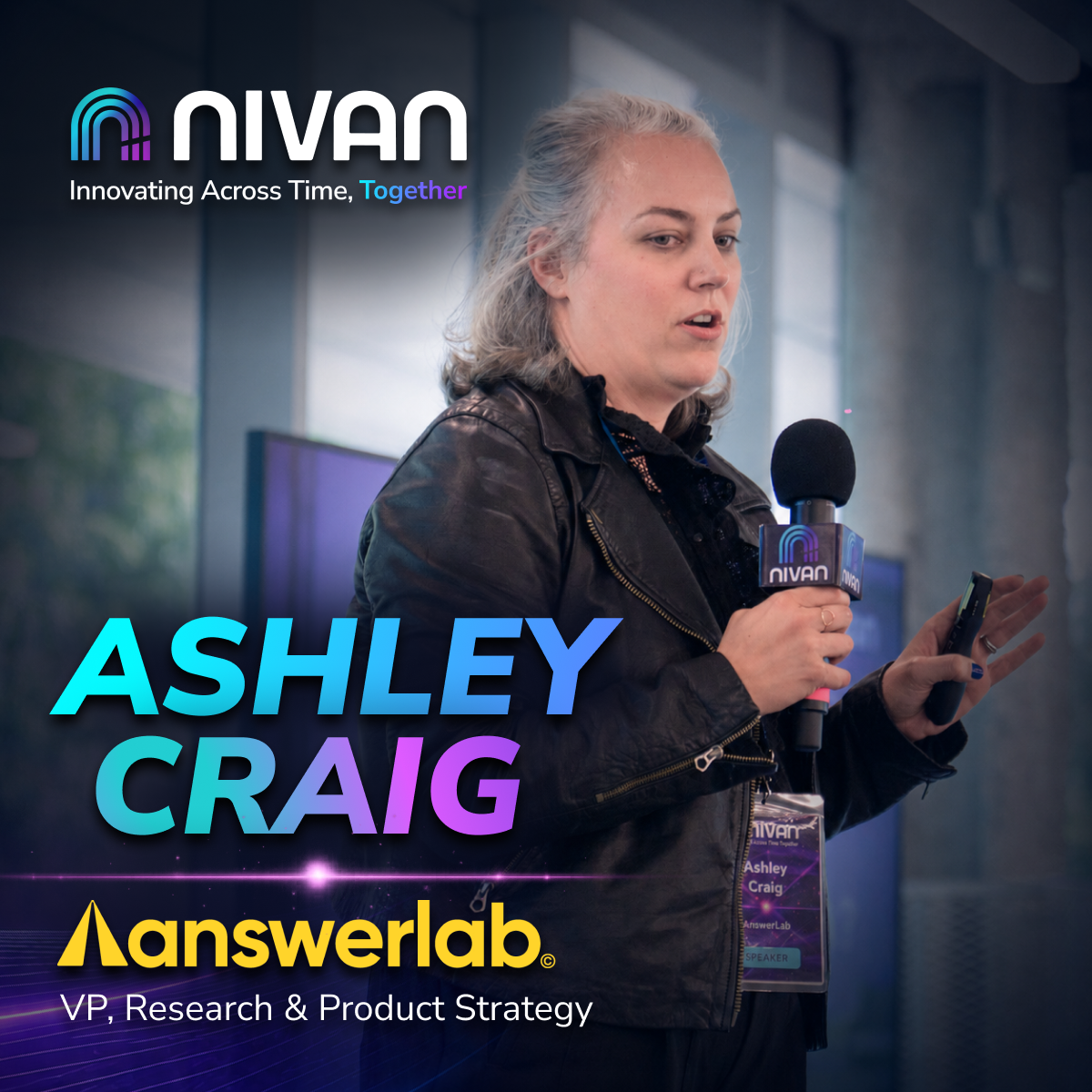
Ashley Craig at Nivan 2026
The gut decision that was not one
Ashley opened with a product leader at another conference describing a decision she had made against her dashboards, which she called a gut call. Pressed on what she had actually done, the leader described visiting customers, watching them use the product, noticing behaviour that contradicted the metrics, and betting on it. Ashley's response was that this was a hypothesis, tested through observation, which is a definition of data. The leader paused and agreed.
Data with a capital D
That exchange exposes the real problem. In that room, and Ashley argues in most product organisations, data means dashboards, instrumentation and possibly voice of customer systems. Those are the systems that have been built, invested in and elevated to the centre of decision making. Qualitative research and ethnographic observation sit in an organisational limbo, considered helpful and interesting and rarely treated as evidence of equal standing.
Invention is rarer than we admit
She was direct about the honest shape of product development. Some products begin with genuine invention, where the territory is unmapped and the work is discovery. Most begin somewhere inside an existing paradigm, improving what already exists and solving a human problem better than it has been solved. That is not a criticism, and pretending otherwise distorts what teams believe they are doing.
How the infrastructure got built
Once a paradigm stabilises and behaviour patterns emerge, the question changes from what this should be to how to make it better, and the tools follow. Dashboards, instrumentation and split testing exist for exactly that moment. Ashley included mature research practices in her own critique, noting that usability testing and concept validation are still human insight in service of refining what already exists.
When measurement stops being a choice
The consequential moment is subtle. When one form of evidence becomes shorthand for evidence itself, the metrics stop being a decision anyone made. They become assumed, embedded in how organisations are structured, how teams are evaluated and how roadmaps are built, until challenging them no longer feels like an available option. She was careful to say the infrastructure is valuable and should not be dismantled.
Why this is the wrong moment for that
The problem is timing. We are not in a stable paradigm. AI is reshaping how people relate to technology faster than measurement systems can track, new behaviours emerge before products exist to support them, and expectations reset continuously. Her sharpest formulation is that we are treating a moment of invention as though it were hyper speed optimisation, made easier by sitting next to infrastructure that updates in real time and feels like an answer even when it is answering the wrong question.
Metrics are values
Fifteen years of helping organisations decide what to measure led her to a firm position. Metrics are not neutral measurement instruments, they are values based incentive systems. They shape behaviour inside the product, among the people building it and among the people using it, which makes selecting them an ethical act as much as an analytical one.
What creators taught her
Leading research with creators on an early stage video platform, the team wanted to know what metrics mattered to creators. What emerged was that creators cared about whatever the platform told them to care about, chasing reach, monetisation and influence rather than anything they valued independently. That is not a creator problem, it is how incentive systems function. We build what our indicators reward and users chase what we signal is valuable.
Consequences we now have evidence for
Rabbit holes, compulsive checking, eroded attention and algorithmic amplification of outrage are not defects in those systems. They are the output of the metrics that were chosen. Ashley did not claim intent, and made the harder point instead. We have evidence now that we did not have then, and the uncomfortable question is whether we act as though we know it, because indicators for the next generation of human technology interaction are being written into roadmaps right now.
The flashlight app problem, at scale
She expects an explosion of AI applications, some transformative, most trivial and some embarrassing, technology in search of a job nobody needs done. The precedent is the early application marketplace and its flashlight apps and fake fireplaces, which the market eventually sorted after enormous energy was spent. This time the barrier to building is lower and the pace is faster.
The device nobody mounted on a wall
Her strongest evidence came from in home ethnography for a consumer device team, with the client present as videographer. The device was designed to be wall mounted because the data said people dislike counter clutter, and that assumption was baked into product, packaging and the experience model. Not one participant had mounted it. Everyone had improvised a stack of books or a spare stand, so a product intended to reduce clutter created more of it. The large screen was similarly misread. Bigger was not the value, multitasking was, and one customer wanting to watch news while monitoring security cameras was forced into one mode at a time. She had filed no ticket and left no review, and none of it appeared in the dashboard.
Two provocations
Ashley closed with one provocation for practitioners and one for leaders. To researchers, designers and strategists, this is not the moment to become rigid about rigour or to defend the discipline. You know how to be with people, how to find signal in behaviour before it becomes data, and how to test a hypothesis before the paradigm locks in. Reinvent the practice rather than protect it. To product leaders, the optimisation infrastructure took years and real investment, and the same investment is now needed alongside it in genuine insight capability. It may slow planning and it will speed development, and it produces the thing hardest to manufacture and easiest to lose, which is a product people trust. Data was never supposed to define the future. That was always our job.
